NVAMediumJEE 2025Covalent Bonding & Lewis Structures

JEE Chemistry 2025 Question with Solution

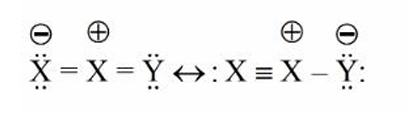
Resonance in X2YX_2Y can be represented as

Two resonance structures of X2Y are shown with charge separation, one with X=X=Y and the other with X≡X−Y, including lone pairs and formal charges on atoms.

The enthalpy of formation of X2YX_2Y is 80kJ mol180 \, \text{kJ mol}^{-1}, and the magnitude of resonance energy of X2YX_2Y is:

Answer

Correct answer:98

Step-by-step solution

Standard Method

Given: The enthalpy of formation of X2YX_2Y is 80kJ mol180 \, \text{kJ mol}^{-1}. The resonance forms indicate delocalization and hence extra stabilization.

Find: The magnitude of the resonance energy of X2YX_2Y.

From the bond-energy calculation shown in the solution:

Energy required to break bonds=940+12×500=1190kJ mol1\text{Energy required to break bonds} = 940 + \frac{1}{2}\times 500 = 1190 \, \text{kJ mol}^{-1} Energy released on bond formation=410+602=1012kJ mol1\text{Energy released on bond formation} = 410 + 602 = 1012 \, \text{kJ mol}^{-1}

Therefore, the expected enthalpy of formation without resonance is

ΔHexpected=11901012=178kJ mol1\Delta H_{\text{expected}} = 1190 - 1012 = 178 \, \text{kJ mol}^{-1}

The actual enthalpy of formation is

ΔHactual=80kJ mol1\Delta H_{\text{actual}} = 80 \, \text{kJ mol}^{-1}

So, the resonance energy is

RE=ΔHexpectedΔHactual=17880=98kJ mol1\text{RE} = \left|\Delta H_{\text{expected}} - \Delta H_{\text{actual}}\right| = |178 - 80| = 98 \, \text{kJ mol}^{-1}

Therefore, the magnitude of resonance energy is 98kJ mol198 \, \text{kJ mol}^{-1}.

Bond Enthalpy Breakdown

Given:

  • Break X=XX=X bond: 940kJ mol1940 \, \text{kJ mol}^{-1}
  • Break 12Y=Y\frac{1}{2}Y=Y bond: 250kJ mol1250 \, \text{kJ mol}^{-1}
  • Form one XXX-X bond: 410kJ mol1410 \, \text{kJ mol}^{-1}
  • Form one XYX-Y bond: 602kJ mol1602 \, \text{kJ mol}^{-1}
  • Actual enthalpy of formation of X2YX_2Y: 80kJ mol180 \, \text{kJ mol}^{-1}

Find: Resonance energy.

First calculate total bond breaking energy:

940+250=1190kJ mol1940 + 250 = 1190 \, \text{kJ mol}^{-1}

Now calculate total bond formation energy:

410+602=1012kJ mol1410 + 602 = 1012 \, \text{kJ mol}^{-1}

Hence, the hypothetical enthalpy of formation without resonance is

11901012=178kJ mol11190 - 1012 = 178 \, \text{kJ mol}^{-1}

Because resonance stabilizes the molecule, the actual enthalpy is lower than this expected value. Thus,

Resonance energy=17880=98kJ mol1\text{Resonance energy} = 178 - 80 = 98 \, \text{kJ mol}^{-1}

Therefore, the required numerical value is 98.

Common mistakes

  • Using the actual enthalpy of formation directly as the resonance energy is incorrect because resonance energy is the difference between the expected non-resonating value and the actual value. First calculate the expected enthalpy, then subtract the actual enthalpy.

  • Ignoring the bond-breaking and bond-forming sign convention leads to a wrong expected enthalpy. Add energies required to break bonds, subtract energies released on bond formation, and only then compare with the actual enthalpy.

  • Forgetting the stoichiometric factor 12\frac{1}{2} for the Y=YY=Y bond gives the wrong input energy. Use 12×500=250kJ mol1\frac{1}{2}\times 500 = 250 \, \text{kJ mol}^{-1}, not the full bond enthalpy.

Practice more Covalent Bonding & Lewis Structures questions

Get unlimited AI-adaptive practice, mastery tracking, and an AI tutor that explains every step — free to start.

Related questions