
Match the LIST-I with LIST-II:
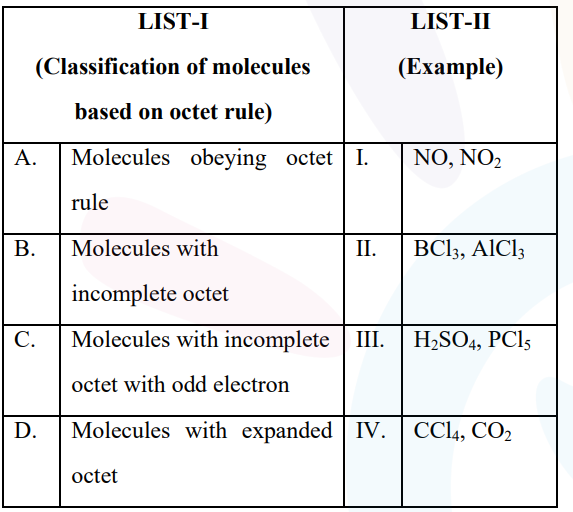
Choose the correct answer from the options given below :
- A
A-IV, B-II, C-I, D-III
- B
A-III, B-II, C-I, D-IV
- C
A-IV, B-I, C-III, D-II
- D
A-II, B-IV, C-III, D-I
Match the LIST-I with LIST-II:
Choose the correct answer from the options given below :
A-IV, B-II, C-I, D-III
A-III, B-II, C-I, D-IV
A-IV, B-I, C-III, D-II
A-II, B-IV, C-III, D-I
Correct answer:D
Standard Method
Given: A matching problem on thermodynamic processes.
Find: The correct correspondence between the statements in List-I and the processes in List-II.
From the extracted solution table:
Use the basic thermodynamic definitions:
Hence pressure varies inversely with volume. Therefore A III.
In an isobaric process, pressure remains constant and the heat supplied is used partly to increase internal energy and partly to do work. Therefore B IV.
In an adiabatic process, no heat is exchanged with the surroundings, so
Therefore C I.
Therefore D II.
Thus the correct matching is:
the solution explicitly states The Correct Option is D. However, this mapping does not match any option verbatim. Among the given options, Option D is marked correct on the solution, so the answer is taken as D with this discrepancy noted.
Concept-wise Matching
Given: Descriptions of four thermodynamic situations.
Find: Which process name matches each description.
when .
So the matching is A-III, B-IV, C-I, D-II.
The source solution still declares Option D as correct, and by the answer-resolution rule the solution is treated. Therefore, the recorded answer is D, while the textual matching from the same solution indicates a mismatch with the listed options.
Confusing adiabatic with isothermal. In an adiabatic process, no heat exchange occurs, whereas in an isothermal process the temperature remains constant. Use the defining condition first: means adiabatic.
Assuming no work done means no heat exchange. That is incorrect. No work done on or by a gas usually indicates constant volume, so and therefore . This identifies an isochoric process, not necessarily an adiabatic one.
Matching inverse - relation with an isobaric process. In an isobaric process pressure is constant, so it cannot vary inversely with volume. The relation corresponds to an isothermal process for an ideal gas.
Get unlimited AI-adaptive practice, mastery tracking, and an AI tutor that explains every step — free to start.