
Match the LIST-I with LIST-II
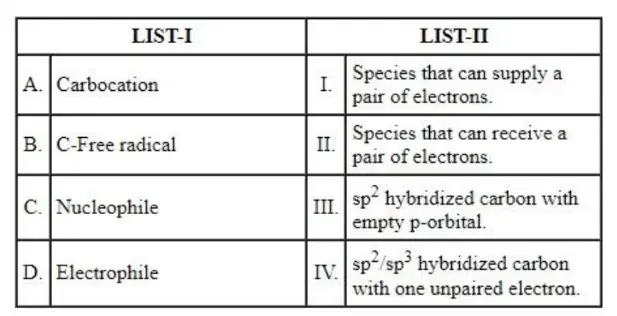
Choose the correct answer from the options given below:
- A
A-III, B-III, C-I, D-IV
- B
A-III, B-IV, C-II, D-I
- C
A-IV, B-II, C-III, D-I
- D
A-III, B-IV, C-I, D-II
Match the LIST-I with LIST-II
Choose the correct answer from the options given below:
A-III, B-III, C-I, D-IV
A-III, B-IV, C-II, D-I
A-IV, B-II, C-III, D-I
A-III, B-IV, C-I, D-II
Correct answer:D
Standard Method
Given: LIST-I contains Carbocation, C-Free radical, Nucleophile and Electrophile. LIST-II contains their definitions or characteristics.
Find: The correct matching between LIST-I and LIST-II.
A carbocation is a positively charged carbon species. It is electron deficient and has an empty -orbital. Therefore, A (Carbocation) matches III.
A C-Free radical has one unpaired electron. Such a carbon species can be described as hybridized with one unpaired electron. Therefore, B (C-Free radical) matches IV.
A nucleophile donates a pair of electrons. Therefore, C (Nucleophile) matches I.
An electrophile accepts a pair of electrons because it is electron deficient. Therefore, D (Electrophile) matches II.
So the correct matching is:
Therefore, the correct option is D.
Definition-Based Matching
Given:
Find: Which description in LIST-II corresponds to each species.
Key ideas:
Now match one by one:
Hence the final matching is A-III, B-IV, C-I, D-II, so the correct option is D.
Confusing nucleophile with electrophile. A nucleophile donates an electron pair, while an electrophile accepts an electron pair. Match them using electron-pair donation and acceptance, not by memorizing names alone.
Matching carbocation with the free-radical description. A carbocation has an empty -orbital and is electron deficient, whereas a free radical has one unpaired electron. Check whether the species has a positive charge or an unpaired electron.
Assuming C-Free radical must always be only hybridized. The listed description explicitly allows hybridization with one unpaired electron. Use the given statement in LIST-II carefully.
Get unlimited AI-adaptive practice, mastery tracking, and an AI tutor that explains every step — free to start.