MCQMediumJEE 2026Reaction Mechanisms (Substitution, Addition, Elimination)

JEE Chemistry 2026 Question with Solution

AA is a neutral organic compound (M.F.: C8H9ONC_8H_9ON). On treatment with aqueous Br2/HOBr_2/HO^-, AA forms a compound BB which is soluble in dilute acid. BB on treatment with aqueous NaNO2/HClNaNO_2/HCl (05C0\text{--}5^\circ \text{C}) produces a compound CC which on treatment with CuCN/NaCNCuCN/NaCN produces DD. Hydrolysis of DD produces EE which is also obtainable from the hydrolysis of AA. EE on treatment with acidified KMnO4KMnO_4 produces FF. FF contains two different types of hydrogen atoms. The structure of AA is

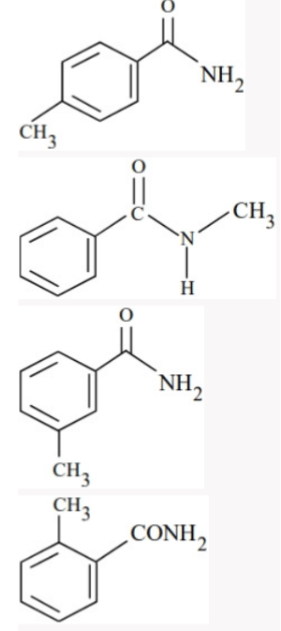
Four aromatic amide structure options are shown, including positional isomers of methyl benzamide and an N-methyl benzamide structure.
  • A

    mm-methyl benzamide

  • B

    NN-methyl benzamide

  • C

    oo-methyl benzamide

  • D

    oo-toluamide

Answer

Correct answer:A

Step-by-step solution

Standard Method

Given: AA has molecular formula C8H9ONC_8H_9ON and gives BB with aqueous Br2/HOBr_2/HO^-. Compound BB undergoes diazotization with aqueous NaNO2/HClNaNO_2/HCl at 05C0\text{--}5^\circ \text{C} to form CC, which with CuCN/NaCNCuCN/NaCN gives DD. Hydrolysis of DD gives EE, and EE is also formed by hydrolysis of AA. Oxidation of EE with acidified KMnO4KMnO_4 gives FF having two different types of hydrogen atoms.

Find: The structure of AA.

Aqueous Br2/HOBr_2/HO^- indicates the Hofmann bromamide reaction, so AA must be an amide and BB must be an amine with one fewer carbon atom.

The molecular formula C8H9ONC_8H_9ON is consistent with a methyl-substituted benzamide.

Diazotization of aromatic amine BB with aqueous NaNO2/HClNaNO_2/HCl at 05C0\text{--}5^\circ \text{C} forms diazonium salt CC. Reaction with CuCN/NaCNCuCN/NaCN replaces the diazonium group by CN-CN to give nitrile DD. Hydrolysis of nitrile DD gives carboxylic acid EE.

Since hydrolysis of AA also gives the same acid EE, AA must be the corresponding benzamide derivative.

Oxidation of EE with acidified KMnO4KMnO_4 converts the methyl group into another carboxylic acid group. The product FF has two different types of hydrogen atoms, which matches a meta-substituted benzenedicarboxylic acid.

Therefore, among the given options, only mm-methyl benzamide satisfies all the conditions.

The correct option is A.

Reaction Sequence Tracking

Given: The sequence is amide \to amine \to diazonium salt \to nitrile \to carboxylic acid \to oxidation product.

Find: Which option fits the full sequence.

  1. From aqueous Br2/HOBr_2/HO^-, identify Hofmann bromamide degradation:
amideamine with one less carbon\text{amide} \longrightarrow \text{amine with one less carbon}

So AA must be a benzamide derivative, not an NN-substituted amide that would not fit the later sequence.

  1. The amine BB must be an aromatic primary amine because it gives a diazonium salt with aqueous NaNO2/HClNaNO_2/HCl at 05C0\text{--}5^\circ \text{C}.

  2. Sandmeyer replacement gives:

ArN2+ArCN\text{ArN}_2^+ \longrightarrow \text{ArCN}

Then hydrolysis gives:

ArCNArCOOH\text{ArCN} \longrightarrow \text{ArCOOH}

Thus EE is a methyl-substituted benzoic acid.

  1. Hydrolysis of AA also gives the same methyl-substituted benzoic acid, confirming that AA is the corresponding methyl benzamide.

  2. On oxidation of EE, the methyl group becomes COOH-COOH. The resulting dicarboxylic acid FF is said to contain two different types of hydrogen atoms. This excludes the symmetric para isomer and matches the meta isomer.

Hence AA is mm-methyl benzamide.

Therefore, the correct option is A.

Common mistakes

  • Mistake: Identifying Br2/HOBr_2/HO^- as ordinary bromination instead of Hofmann bromamide reaction. Why wrong: the reagent converts an amide into an amine with one fewer carbon here. What to do instead: recognize the functional-group transformation first and infer that AA must be a benzamide derivative.

  • Mistake: Ignoring that BB is soluble in dilute acid. Why wrong: this strongly indicates that BB is an amine, because it forms an ammonium salt in acid. What to do instead: use acid solubility as a diagnostic clue for aromatic amines.

  • Mistake: Choosing the ortho or other isomer without checking the final oxidation product FF. Why wrong: the number of distinct hydrogen environments in the final dicarboxylic acid helps determine the substitution pattern. What to do instead: test each positional isomer against the symmetry information given for FF.

Practice more Reaction Mechanisms (Substitution, Addition, Elimination) questions

Get unlimited AI-adaptive practice, mastery tracking, and an AI tutor that explains every step — free to start.

Related questions