
A(g) B(g) + C(g) is a first order reaction.
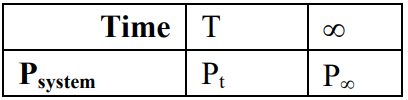
The reaction was started with reactant A only. Which of the following expression is correct for rate constant ?
- A
- B
- C
- D
A(g) B(g) + C(g) is a first order reaction.
The reaction was started with reactant A only. Which of the following expression is correct for rate constant ?
Correct answer:C
Standard Method
Given: is a first-order reaction. The total pressure at time is and at completion it is .
Find: The correct expression for the rate constant .
Let the initial pressure of be . If pressure corresponding to reacted at time is , then
So the total pressure at time is
Hence,
and therefore
At , the reaction is complete, so
Thus,
Substituting into ,
For a first-order reaction,
Now substitute and :
Therefore, the correct option is C.
Pressure-Stoichiometry Approach
Given: Only reactant is present initially for the reaction .
Find: Expression of in terms of and .
The key idea is to relate the partial pressure of unreacted to the measured total pressure.
At any time , if reacted pressure is , then the species pressures are
So,
which gives
Hence,
At completion,
Therefore,
So,
and
Using the integrated first-order law,
For gases at constant temperature, concentration is proportional to partial pressure, so
Substituting the pressure relations,
This matches option (3), so the correct option is C.
Using total pressure directly in the first-order formula is incorrect because the rate law depends on the partial pressure of unreacted , not the total system pressure. First express in terms of and , then substitute into the integrated law.
Assuming without deriving can lead to confusion. The stoichiometry doubles the total number of gas moles at completion, so this relation must be established first.
Forgetting that only is present initially is a conceptual error. If products were initially present, the pressure relations would change. Use the given initial condition to write and at .
Get unlimited AI-adaptive practice, mastery tracking, and an AI tutor that explains every step — free to start.