
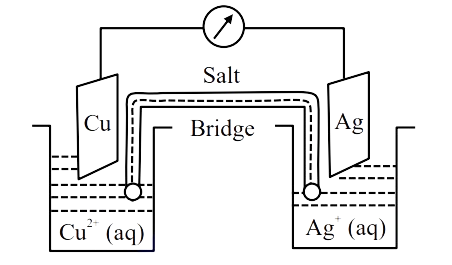
1 Faraday electricity was passed through (, )/Cu and Faraday was passed through (, ) electrolytic cells. After this, the two cells were connected as shown below to make an electrochemical cell. The emf of the cell thus formed at is:
Given:
1 Faraday electricity was passed through (, )/Cu and Faraday was passed through (, ) electrolytic cells. After this, the two cells were connected as shown below to make an electrochemical cell. The emf of the cell thus formed at is:
Given:
Correct answer:0.4
Standard Method
Given: Standard reduction potentials are and . The solution states that after forming the cell, the emf is obtained using the Nernst equation and gives the final value .
Find: The emf of the electrochemical cell at .
Using the standard potentials:
the solution then applies the Nernst equation in the form:
It uses:
and substitutes:
Now,
So,
Therefore, the emf of the cell is . Hence the numerical answer is 0.4.
Note: The solution does not consistently show the concentration changes after electrolysis, but it explicitly concludes the final emf as , which is taken as the answer.
Using the extracted stepwise working
Given: the solution provides the standard potentials and a stepwise Nernst-equation approach.
Find: The final emf after the two electrolytic cells are connected.
From the extracted working:
So the emf is approximately .
Therefore, the required numerical value is 0.4.
Using only the standard emf difference and stopping at is incorrect because the cell is non-standard after electrolysis. The Nernst correction must be applied to account for ion concentrations.
Writing the reaction quotient in the wrong orientation is a common mistake. In the extracted solution, is used; reversing this ratio changes the sign of the logarithmic term and gives the wrong emf.
Ignoring that the question involves electrolysis before cell construction can lead to conceptual confusion. The concentration state of each half-cell after passing charge matters; do not treat the problem as a direct standard-potential question.
Get unlimited AI-adaptive practice, mastery tracking, and an AI tutor that explains every step — free to start.