MCQMediumJEE 2025Integrated Rate Laws

JEE Chemistry 2025 Question with Solution

Reaction A(g)2B(g)+C(g)A\text{(g)} \rightarrow 2B\text{(g)} + C\text{(g)} is a first-order reaction. It was started with pure AA.

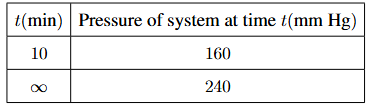
The following table shows the pressure of the system at different times:

Table showing pressure of the system at different times: at time 10 min, pressure is 160 mm Hg; at infinite time, pressure is 240 mm Hg.

Which of the following options is incorrect?

  • A

    Initial pressure of AA is 80mm Hg80 \, \text{mm Hg}

  • B

    The reaction never goes to completion

  • C

    Rate constant of the reaction is 1.693min11.693 \, \text{min}^{-1}

  • D

    Partial pressure of AA after 10minutes10 \, \text{minutes} is 40mm Hg40 \, \text{mm Hg}

Answer

Correct answer:C

Step-by-step solution

Standard Method

Given: Reaction A(g)2B(g)+C(g)A\text{(g)} \rightarrow 2B\text{(g)} + C\text{(g)} is first order and starts with pure AA. The total pressure is 160mm Hg160 \, \text{mm Hg} at t=10mint = 10 \, \text{min} and 240mm Hg240 \, \text{mm Hg} at tt \to \infty.

Find: Which statement is incorrect.

At completion, 11 mole of AA gives 33 moles of gaseous products, so the final pressure is three times the initial pressure.

P=3P0P_{\infty} = 3P_0240=3P0240 = 3P_0P0=80mm HgP_0 = 80 \, \text{mm Hg}

So statement (1) is correct.

For a first-order reaction, the reactant amount decreases exponentially and approaches zero asymptotically. Hence statement (2) is taken as correct in the given solution.

At t=10mint = 10 \, \text{min}, use

kt=ln(PP0PPt)kt = \ln \left( \frac{P_{\infty} - P_0}{P_{\infty} - P_t} \right)

Substituting the values,

10k=ln(24080240160)10k = \ln \left( \frac{240 - 80}{240 - 160} \right)10k=ln(16080)=ln210k = \ln \left( \frac{160}{80} \right) = \ln 2k=0.69310=0.0693min1k = \frac{0.693}{10} = 0.0693 \, \text{min}^{-1}

Therefore, the rate constant is 0.0693min10.0693 \, \text{min}^{-1}, not 1.693min11.693 \, \text{min}^{-1}. So statement (3) is incorrect.

Also, the partial pressure of AA after 10min10 \, \text{min} is 40mm Hg40 \, \text{mm Hg}, so statement (4) is correct.

Therefore, the correct option is C.

Pressure Method in Terms of Reactant Pressure

Given: Initial total pressure is due only to AA. At tt \to \infty, total pressure is 240mm Hg240 \, \text{mm Hg}.

Find: Check the four statements using reactant pressure.

Since

P0=80mm HgP_0 = 80 \, \text{mm Hg}

let the pressure of AA remaining after 10min10 \, \text{min} be PAP_A. If xx pressure equivalent of AA decomposes, then total pressure becomes

Pt=(80x)+2x+x=80+2xP_t = (80 - x) + 2x + x = 80 + 2x

At t=10mint = 10 \, \text{min},

160=80+2x160 = 80 + 2x2x=802x = 80x=40x = 40

Hence,

PA=8040=40mm HgP_A = 80 - 40 = 40 \, \text{mm Hg}

Now apply the first-order law:

kt=ln(PA,0PA)kt = \ln \left( \frac{P_{A,0}}{P_A} \right)10k=ln(8040)=ln210k = \ln \left( \frac{80}{40} \right) = \ln 2k=0.0693min1k = 0.0693 \, \text{min}^{-1}

Thus statement (4) is correct, while statement (3) is incorrect.

Therefore, the incorrect option is C.

Common mistakes

  • Using the total pressure PtP_t directly in the first-order formula is incorrect because the integrated law applies to the pressure or concentration of reactant AA, not the total pressure. First convert total pressure into partial pressure of AA or use the corrected relation involving PP_{\infty}.

  • Assuming P=P0P_{\infty} = P_0 is wrong because the number of gaseous moles changes from 11 to 33. The total pressure increases as the reaction proceeds, so the final pressure must be related stoichiometrically to the initial pressure.

  • Reading 1.693min11.693 \, \text{min}^{-1} from ln2\ln 2 is incorrect. Since ln2=0.693\ln 2 = 0.693, dividing by 10min10 \, \text{min} gives 0.0693min10.0693 \, \text{min}^{-1}, not 1.693min11.693 \, \text{min}^{-1}.

Practice more Integrated Rate Laws questions

Get unlimited AI-adaptive practice, mastery tracking, and an AI tutor that explains every step — free to start.

Related questions