
An ideal gas has undergone through the cyclic process as shown in the figure. Work done by the gas in the entire cycle is _____ J. (Take )
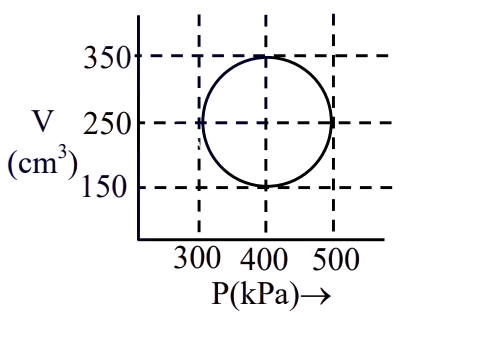
An ideal gas has undergone through the cyclic process as shown in the figure. Work done by the gas in the entire cycle is _____ J. (Take )
Correct answer:31.4
Standard Method
Given: The graph is a circle in the diagram for a cyclic process.
Find: Work done by the gas in the entire cycle.
For a cyclic process, the work done by the gas is equal to the area enclosed by the cycle.
From the graph:
Using the area of the circular loop,
with units .
Now convert units:
So,
Hence, in the asked form,
Therefore, the required numerical value is .
Using ellipse area form
Given: The diameters of the circular path on the axes are read directly from the graph.
Find: The work done enclosed by the loop.
The enclosed area can also be written as
where
and
Substituting,
Thus the work done is .
Since the question asks for the value in the form _____ J, the required entry is .
Treating the work done in a cyclic process as zero. This is wrong because over a complete cycle the change in internal energy may be zero, but the work done equals the area enclosed on the diagram. Always compute the enclosed area.
Using the full diameter as the radius. This is wrong because the pressure span is from to and the volume span is from to , so the radius is half of each span, not the full difference.
Missing the unit conversion from to joule. This gives an answer larger by a factor of . Use .
Get unlimited AI-adaptive practice, mastery tracking, and an AI tutor that explains every step — free to start.