
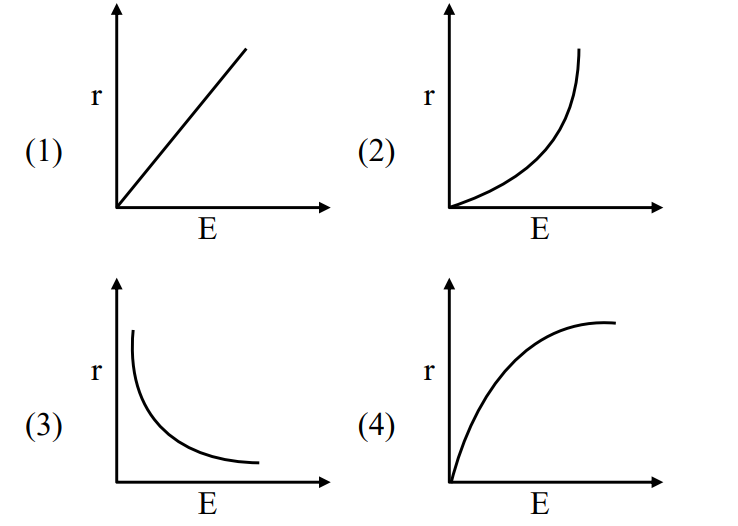
A particle of charge , mass , and kinetic energy enters in a magnetic field perpendicular to its velocity and undergoes a circular arc of radius . Which of the following curves represents the variation of with ?
- A
(1)
- B
(2)
- C
(3)
- D
(4)
A particle of charge , mass , and kinetic energy enters in a magnetic field perpendicular to its velocity and undergoes a circular arc of radius . Which of the following curves represents the variation of with ?
(1)
(2)
(3)
(4)
Correct answer:D
Standard Method
Given: A particle of charge and mass enters a magnetic field perpendicular to its velocity and moves in a circle of radius .
Find: The graph of versus kinetic energy .
For circular motion in a magnetic field,
Also, kinetic energy is
So,
Substituting in the expression for ,
Therefore,
Hence increases with , but the rate of increase gradually decreases. So the required curve is option (4).
Therefore, the correct option is D.
Using force and energy relation
Given: Magnetic force provides the centripetal force for the charged particle.
Find: The correct -versus- graph.
Using magnetic force equals centripetal force,
This gives
Now,
Using ,
So,
which means
Thus the graph is an increasing curve concave downward, matching option (4).
Therefore, the correct option is D.
Assuming is incorrect because radius depends on velocity, not directly on kinetic energy. First convert to using , then substitute into the radius formula.
Choosing a decreasing graph is wrong because higher kinetic energy means higher speed, and for fixed and the radius increases with speed. The radius cannot decrease with increasing here.
Confusing with a straight-line graph of versus is a conceptual error. A straight line would represent , whereas gives a curved graph.
Get unlimited AI-adaptive practice, mastery tracking, and an AI tutor that explains every step — free to start.