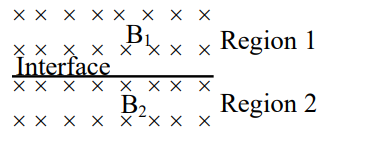
Uniform magnetic fields of different strengths B1 and B2, both normal to the plane of the paper, exist as shown in the figure. A charged particle of mass m and charge q, at the interface at an instant, moves into region 2 with velocity v and returns to the interface. It continues to move into region 1 and finally reaches the interface. What is the displacement of the particle during this movement along the interface?
Consider the velocity of the particle to be normal to the magnetic field and B2>B1.
A
qB1mv(1−B1B2)×2
B
qB1mv(1−B2B1)
C
qB1mv(1−B1B2)
D
qB1mv(1−B2B1)×2
Answer
Correct answer:D
Step-by-step solution
Standard Method
Given: A charged particle with mass m, charge q and speed v moves perpendicular to uniform magnetic fields B1 and B2 in two adjacent regions. Find: the displacement along the interface after the particle goes into region 2, returns to the interface, then goes into region 1 and again reaches the interface.
Since v⊥B, the particle moves in a circular path in each region with radius
R=qBmv
Therefore, in region 1,
R1=qB1mv
and in region 2,
R2=qB2mv
The motion in each region contributes a diameter along the interface. Hence the net displacement along the interface is
AC=CD−AD
Using the diameters in the two regions,
AC=2R1−2R2
Substituting the radii,
AC=qB12mv−qB22mv
Taking common factor,
AC=qB12mv(1−B2B1)
Therefore, the displacement along the interface is qB12mv(1−B2B1), so the correct option is D.
Using radii in the two magnetic regions
Given: The particle enters two regions having magnetic fields B1 and B2 with B2>B1, and its velocity is perpendicular to the magnetic field. Find: the total displacement along the interface.
The magnetic force provides the centripetal force, so the path is circular in each region. The radius depends inversely on magnetic field strength:
R=qBmv
Thus,
R1=qB1mv,R2=qB2mv
Because B2>B1,
R2<R1
From the geometry of the two semicircular parts of the trajectory, the displacement along the interface equals the difference of the corresponding diameters:
Using R=mvqB instead of R=qBmv. This reverses the dependence on magnetic field and gives the wrong displacement. Always obtain the radius from centripetal force balance for magnetic motion.
Forgetting that the displacement along the interface involves diameters of the circular arcs, not just radii. Using R1−R2 instead of 2R1−2R2 misses the factor of 2.
Assuming the larger magnetic field gives the larger radius. Since R∝B1 for fixed m,q, and v, the stronger field B2 produces the smaller circular arc.
Practice more Force on Moving Charge questions
Get unlimited AI-adaptive practice, mastery tracking, and an AI tutor that explains every step — free to start.