MCQEasyJEE 2025Hybridisation

JEE Chemistry 2025 Question with Solution

Given below are two statements:

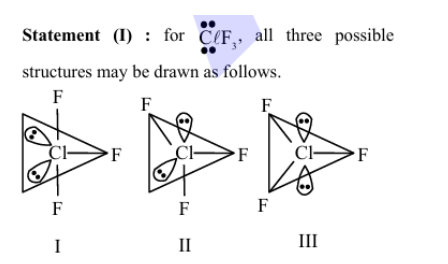
Three trigonal bipyramidal arrangements for ClF3 labeled I, II, and III, showing fluorine atoms and lone pairs placed at different axial and equatorial positions.

Statement (II): Structure III is most stable, as the orbitals having the lone pairs are axial, where the pβp\ell p - \beta p repulsion is minimum. In light of the above statements, choose the most appropriate answer from the options given below:

  • A

    Statement I is incorrect but Statement II is correct

  • B

    Statement I is correct but Statement II is incorrect

  • C

    Both Statement I and Statement II are correct

  • D

    Both Statement I and Statement II are incorrect

Answer

Correct answer:B

Step-by-step solution

Standard Method

Given: The question asks about the correctness of two statements for ClF3\text{ClF}_3.

Find: Which option correctly identifies whether Statement I and Statement II are correct or incorrect.

For ClF3\text{ClF}_3, chlorine has 55 electron pairs around the central atom: 33 bond pairs and 22 lone pairs. The electron-pair arrangement is trigonal bipyramidal.

In a trigonal bipyramidal arrangement, lone pairs prefer equatorial positions because this minimizes lone pair-bond pair repulsion. Axial positions experience greater repulsion than equatorial positions for lone pairs.

So, Statement I is correct because all three possible structures can be drawn for ClF3\text{ClF}_3.

Statement II says that structure III is most stable because the lone pairs are axial and therefore pβp\ell p - \beta p repulsion is minimum. This is incorrect, because lone pairs are more stable in equatorial positions, not axial positions.

Therefore, Statement I is correct but Statement II is incorrect. The correct option is B.

Detailed Reasoning

Given: Statements about the stability of structures of ClF3\text{ClF}_3.

Find: Evaluate both statements using lone pair position preference in sp3dsp^3d hybridization.

The central atom Cl in ClF3\text{ClF}_3 has 77 valence electrons. It forms 33 bonds with fluorine atoms, leaving 22 lone pairs on chlorine.

Thus, the steric number is

3+2=53 + 2 = 5

so the electron geometry is trigonal bipyramidal.

In trigonal bipyramidal geometry:

  • an equatorial position has fewer 9090^\circ interactions
  • an axial position has more 9090^\circ interactions

Since lone pairs repel more strongly, they occupy equatorial positions to reduce repulsion.

Hence the claim in Statement II that axial lone pairs give minimum pβp\ell p - \beta p repulsion is opposite to the actual rule. Therefore, Statement II is incorrect.

At the same time, the statement that all three possible structures can be drawn is accepted as correct in the given context. Hence Statement I is correct.

So the final conclusion is: Statement I is correct but Statement II is incorrect, therefore the answer is B.

Common mistakes

  • Assuming that lone pairs prefer axial positions in trigonal bipyramidal geometry is incorrect because axial positions have more 9090^\circ interactions. Lone pairs should be placed in equatorial positions to minimize repulsion.

  • Confusing molecular shape with electron-pair geometry leads to errors. ClF3\text{ClF}_3 has trigonal bipyramidal electron-pair geometry but a T-shaped molecular shape; use lone pair placement based on electron geometry.

  • Treating Statement II as correct only because it mentions minimum repulsion is a trap. The key is to check whether the stated position of the lone pairs actually gives minimum repulsion; here axial does not.

Practice more Hybridisation questions

Get unlimited AI-adaptive practice, mastery tracking, and an AI tutor that explains every step — free to start.

Related questions