
Match List-I with List-II:
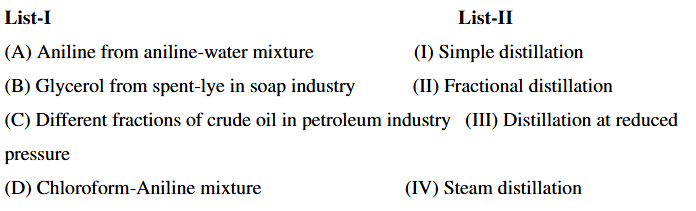
- A
Choose the correct answer from the options given below: (A)-(IV), (B)-(III), (C)-(II), (D)-(I)
- B
(A)-(I), (B)-(II), (C)-(III), (D)-(IV)
- C
(A)-(III), (B)-(II), (C)-(I), (D)-(IV)
- D
(A)-(II), (B)-(I), (C)-(IV), (D)-(III)
Match List-I with List-II:
Choose the correct answer from the options given below: (A)-(IV), (B)-(III), (C)-(II), (D)-(I)
(A)-(I), (B)-(II), (C)-(III), (D)-(IV)
(A)-(III), (B)-(II), (C)-(I), (D)-(IV)
(A)-(II), (B)-(I), (C)-(IV), (D)-(III)
Correct answer:A
Standard Method
Given: A matching question on separation techniques.
Find: The correct correspondence between the cases in List-I and the distillation methods in List-II.
From the solution working:
So the matching is:
This corresponds to option A.
There is a discrepancy in the provided the solution because one line later states a different option, but the step-by-step matching and conclusion above support option A.
Therefore, the correct option is A.
Why each method fits
Given: Four practical separations and four distillation techniques.
Find: The correct one-to-one match.
Applying these ideas:
Hence the final matching is:
So the correct option is A.
Confusing steam distillation with simple distillation for aniline-water mixture. This is wrong because aniline is separated conveniently with steam when dealing with an immiscible high boiling organic liquid. Check whether the organic compound is steam volatile before choosing the method.
Assigning fractional distillation to glycerol recovery. This is wrong because glycerol has a high boiling point and may decompose on strong heating. Use reduced pressure distillation for such compounds.
Treating crude oil separation as simple distillation. This is incorrect because crude oil contains many components with a range of boiling points. Use fractional distillation when multiple fractions are separated.
Get unlimited AI-adaptive practice, mastery tracking, and an AI tutor that explains every step — free to start.