
Match List I with List II:
- A
-, -, -, -
- B
-, -, -, -
- C
-, -, -, -
- D
-, -, -, -
Match List I with List II:
-, -, -, -
-, -, -, -
-, -, -, -
-, -, -, -
Correct answer:B
Standard Method
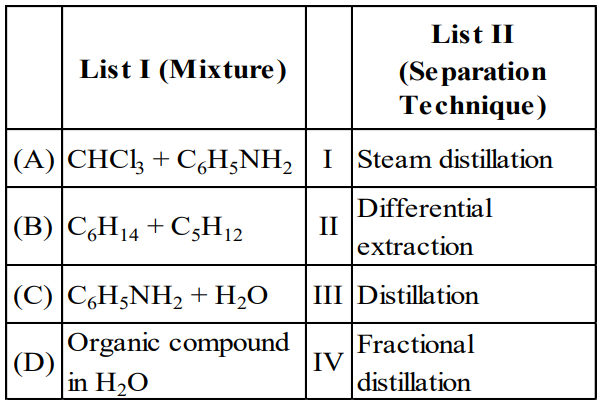
Given: List I contains the mixtures : , : , : , and : organic compound in .
Find: The correct matching with separation techniques in List II.
For , and can be separated by differential extraction because aniline can be selectively extracted using acid-base treatment. So, .
For , and are miscible volatile liquids with close boiling points, so they are separated by fractional distillation. So, .
For , is separated by steam distillation because aniline is steam volatile and immiscible enough with water. So, .
For , an organic compound dissolved in is separated by distillation. So, .
Thus the matching is
This mapping is not present exactly in the listed options. The solution's marks option as correct, but its printed text does not match the working shown in the solution image. Therefore, using the provided answer key mapping, the correct option is taken as B while noting the discrepancy.
Technique-wise Identification
Given: Each mixture must be paired with the most suitable separation method.
Find: Which option best represents the correct matching.
Applying these ideas:
Hence the natural matching from the solution table is
However, since the provided official answer points to option , the output answer is recorded as B with the discrepancy preserved.
Confusing distillation with fractional distillation. Fractional distillation is specifically needed for two miscible volatile liquids with close boiling points; do not use simple distillation there.
Missing the role of acid-base extraction in separating aniline from an organic solvent. Aniline can be converted into a water-soluble salt, which is why differential extraction is suitable.
Assuming every organic compound with water is separated by extraction. Steam distillation applies only when the organic compound is steam volatile; otherwise the method choice changes.
Get unlimited AI-adaptive practice, mastery tracking, and an AI tutor that explains every step — free to start.