MCQMediumJEE 2025Electronic Effects (Inductive, Resonance, Hyperconjugation)

JEE Chemistry 2025 Question with Solution

In which pairs, the first ion is more stable than the second?
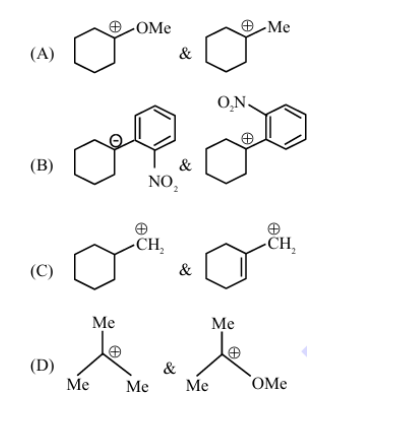
Four ion pairs labeled A, B, C and D are shown with cyclic and tertiary carbocation structures containing OMe, Me, NO2, and exocyclic CH2 groups for stability comparison.
  • A

    (B) & (D) only

  • B

    (A) & (B) only

  • C

    (B) & (C) only

  • D

    (A) & (C) only

Answer

Correct answer:B

Step-by-step solution

Standard Method

Given: Four pairs of ions labeled (A) to (D) are shown in the figure.

Find: In which pairs the first ion is more stable than the second.

From the extracted solution text:

  • In pair (A), the ion with the methoxy group OMe\text{OMe} is more stable than the one with the methyl group Me\text{Me} because the oxygen in the methoxy group can donate electron density via resonance.
  • In pair (B), the first ion is more stable than the second because the second structure contains a nitro-substituted system that is less stabilizing, while the first is comparatively more stable.

Therefore, the pairs satisfying the condition are (A) and (B) only.

So, the correct option is B.

Common mistakes

  • Assuming only inductive effect matters. For these ions, resonance stabilization is crucial; compare whether the substituent can donate or withdraw electron density through conjugation, not only through II-effect.

  • Treating OMe\text{OMe} and Me\text{Me} as equally stabilizing. The methoxy group can provide resonance donation through oxygen, whereas methyl mainly offers weak hyperconjugative or inductive effects.

  • Ignoring the direction of the question. You must identify pairs where the first ion is more stable than the second, not merely the more stable ion in each pair.

Practice more Electronic Effects (Inductive, Resonance, Hyperconjugation) questions

Get unlimited AI-adaptive practice, mastery tracking, and an AI tutor that explains every step — free to start.

Related questions