MCQEasyJEE 2026Electronic Effects (Inductive, Resonance, Hyperconjugation)

JEE Chemistry 2026 Question with Solution

The cyclic cations having the same number of hyperconjugation are:
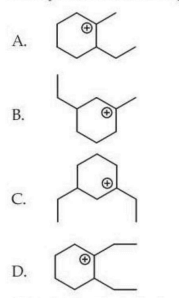
Four labeled cyclic carbocation structures A, B, C and D are shown, each based on a cyclohexyl carbocation framework with different alkyl substituent positions.
  • A

    A, C and D only

  • B

    A and B Only

  • C

    A and C Only

  • D

    B and C Only

Answer

Correct answer:A

Step-by-step solution

Standard Method

Given: Four cyclic carbocations A, B, C and D are shown.

Find: Which cations have the same number of hyperconjugative structures.

Principle: Hyperconjugation in a carbocation depends on the number of available β\beta-hydrogens on the carbon adjacent to the positively charged carbon. Each β\beta-hydrogen gives one hyperconjugative structure.

For A, the carbocation is adjacent to a CH3_3 group, so it has 33 β\beta-hydrogens.

For B, the carbocation is adjacent to a CH2_2 group in the ring, so it has 22 β\beta-hydrogens.

For C, the carbocation is adjacent to a CH3_3 group, so it again has 33 β\beta-hydrogens.

For D, the carbocation is adjacent to a CH3_3 group, so it also has 33 β\beta-hydrogens.

Thus, A, C, and D have the same number of hyperconjugative structures, while B does not.

Therefore, the correct option is A.

Counting $$\beta$$-Hydrogens

Given: Hyperconjugation count is required for the four cyclic cations.

Find: The set of cations having equal hyperconjugation.

Use the rule:

  1. Identify the carbocation center.
  2. Look at the adjacent carbon atom.
  3. Count the hydrogens attached to that adjacent carbon.
  4. That count equals the number of hyperconjugative structures.

Applying this:

  • A \rightarrow adjacent CH3_3 group \rightarrow 33 hyperconjugative structures
  • B \rightarrow adjacent CH2_2 group \rightarrow 22 hyperconjugative structures
  • C \rightarrow adjacent CH3_3 group \rightarrow 33 hyperconjugative structures
  • D \rightarrow adjacent CH3_3 group \rightarrow 33 hyperconjugative structures

So the equal counts occur for A, C and D.

Hence, the correct option is A.

Common mistakes

  • Counting the total number of hydrogens in the whole structure instead of only the β\beta-hydrogens. This is wrong because hyperconjugation in carbocations depends only on hydrogens on carbons adjacent to the positively charged carbon. Count only the adjacent-carbon hydrogens.

  • Treating a CH2_2 group and a CH3_3 group as contributing equally. This is wrong because CH2_2 provides 22 β\beta-hydrogens, while CH3_3 provides 33. Distinguish the adjacent group correctly before comparing structures.

  • Comparing ring size or substitution pattern without locating the carbocation center first. This is wrong because the hyperconjugation count is a local effect near the positive charge. First mark the carbocation carbon, then inspect its neighboring carbons.

Practice more Electronic Effects (Inductive, Resonance, Hyperconjugation) questions

Get unlimited AI-adaptive practice, mastery tracking, and an AI tutor that explains every step — free to start.

Related questions