
Match List-I with List-II.
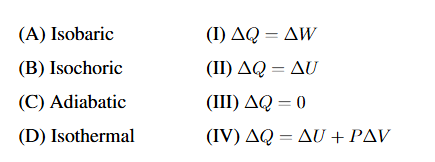
- A
(A)-(IV), (B)-(III), (C)-(II), (D)-(I)
- B
(A)-(IV), (B)-(I), (C)-(III), (D)-(II)
- C
(A)-(IV), (B)-(II), (C)-(III), (D)-(I)
- D
(A)-(I), (B)-(II), (C)-(IV), (D)-(III)
Match List-I with List-II.
(A)-(IV), (B)-(III), (C)-(II), (D)-(I)
(A)-(IV), (B)-(I), (C)-(III), (D)-(II)
(A)-(IV), (B)-(II), (C)-(III), (D)-(I)
(A)-(I), (B)-(II), (C)-(IV), (D)-(III)
Correct answer:C
Standard Method
Given: A matching problem on thermodynamic processes and their heat relations.
Find: The correct correspondence between List-I and List-II.
From the solution:
Hence (A) \rightarrow (IV).
Hence (B) \rightarrow (II).
Hence (C) \rightarrow (III).
Hence (D) \rightarrow (I).
Therefore, the correct matching is (A)-(IV), (B)-(II), (C)-(III), (D)-(I), so the correct option is C.
Using First Law Process-wise
Given: The processes are Isobaric, Isochoric, Adiabatic, and Isothermal.
Find: Which equation matches each process.
Use the first law of thermodynamics:
For an isobaric process, work done at constant pressure is
So,
Thus (A) \rightarrow (IV).
For an isochoric process,
Hence,
Thus (B) \rightarrow (II).
For an adiabatic process,
Thus (C) \rightarrow (III).
For an isothermal process, the provided relation in the list is
Thus (D) \rightarrow (I).
So the final arrangement is (A)-(IV), (B)-(II), (C)-(III), (D)-(I). Therefore, the correct option is C.
The second approach text in the source contains a contradictory description for isobaric and isothermal cases, but it still concludes option (3). The detailed stepwise relation above is consistent with the first approach and the final answer.
Confusing isobaric with isothermal. Constant pressure does not mean constant temperature. In an isobaric process, use , while for the listed isothermal relation use .
Forgetting that in an isochoric process the volume is constant, so no work is done. Writing a nonzero work term is incorrect. Instead, set and use .
Assuming adiabatic means temperature is constant. That is wrong: adiabatic means no heat exchange. The correct identifying relation is .
Get unlimited AI-adaptive practice, mastery tracking, and an AI tutor that explains every step — free to start.