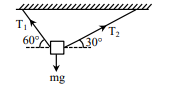
A body of mass is suspended with the help of two strings making angles as shown in the figure. Magnitude of tensions and , respectively, are (in N):
- A
,
- B
,
- C
,
- D
,

A body of mass is suspended with the help of two strings making angles as shown in the figure. Magnitude of tensions and , respectively, are (in N):
,
,
,
,

Correct answer:B
Standard Method
Given: A body of mass is in equilibrium under tensions and . The left string makes with the horizontal and the right string makes with the horizontal.
Find: The magnitudes of and .
For equilibrium, resolve the tensions into horizontal and vertical components and apply
Using , the weight is
Horizontal equilibrium gives
Vertical equilibrium gives
Substitute :
Then
Therefore, the magnitudes of tensions are and . The correct option is B.
Using equilibrium of components
Given: The mass is suspended by two strings and remains at rest.
Find: The pair .
The solution contains an earlier inconsistent working using equal angles, but the detailed approach clearly states the figure angles as and with the horizontal. Using the figure-consistent equilibrium equations:
Write the components:
Horizontal balance:
Vertical balance:
Substitute the relation from horizontal balance:
Hence
So the required pair is , which matches option B.
Using the same angle for both strings is incorrect because the figure shows different angles, on one side and on the other. Resolve each tension with its own angle before writing equilibrium equations.
Interchanging sine and cosine is a common error. Since the angles are given with the horizontal, the horizontal component is and the vertical component is , not the other way around.
Assuming is wrong here because the geometry is not symmetric. Equal tensions occur only when the corresponding angles and arrangement are symmetric.
Get unlimited AI-adaptive practice, mastery tracking, and an AI tutor that explains every step — free to start.