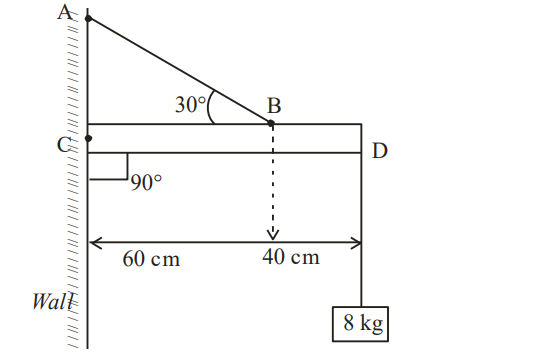
An object of mass is hanging from one end of a uniform rod CD of mass and length pivoted at its end C on a vertical wall. It is supported by a cable AB such that the system is in equilibrium. The tension in the cable is:

- A
- B
- C
- D
An object of mass is hanging from one end of a uniform rod CD of mass and length pivoted at its end C on a vertical wall. It is supported by a cable AB such that the system is in equilibrium. The tension in the cable is:

Correct answer:C
Standard Method
Given: A uniform rod of mass and length is hinged at . A mass of hangs at the end. The cable is attached at point , from , and makes an angle of with the rod.
Find: The tension in the cable.

Taking torque about point :
Therefore,
Therefore, the tension in the cable is . The correct option is C.
The solution states the answer as C. The torque balance uses and distances in cm, which is valid since all lever arms are in the same unit.
Torque Balance with Components
Given: Weight of the rod acts at its centre, from . Weight of the hanging object acts at from . Only the vertical component of tension produces torque about .
Find: Tension .
The vertical component of tension is:
Now balance clockwise and anticlockwise torques about :
Using ,
Therefore, the correct option is C.
Using the full tension as the torque-producing force is incorrect because the cable is inclined. Only the perpendicular component produces torque about the hinge. Resolve the tension first.
Taking the rod's weight to act at the end is wrong. For a uniform rod, its weight acts at the centre of mass, which is from . Always place the rod's weight at its midpoint.
Ignoring the given position of point leads to an incorrect lever arm. The tension acts at from , not at the full length. Use the actual point of application.
Get unlimited AI-adaptive practice, mastery tracking, and an AI tutor that explains every step - free to start.