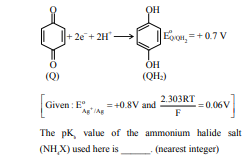
Consider the following electrochemical cell at standard condition. The couple represents quinhydrone electrode, the half cell reaction is given below:

- A
- B
- C
- D
Consider the following electrochemical cell at standard condition. The couple represents quinhydrone electrode, the half cell reaction is given below:

Correct answer:A
Standard Method
Given: The cell potential is . The standard potential of the quinhydrone electrode is . The silver electrode is , so .
Find: The value corresponding to the ammonium halide salt in the quinhydrone half-cell.
The overall cell reaction is
For the quinhydrone electrode, since quinone and hydroquinone are present together, the potential depends on .
First calculate the anode potential using
So,
For the quinhydrone electrode,
which gives
Substituting ,
Now use the hydrolysis of ammonium ion:
With concentration and ,
Assuming small hydrolysis,
Using
Therefore,
So, the correct option is A.
The solution gives the final value as , and this matches option A.
Potential-to-pH Route
Given: The cathode is the silver electrode and the anode is the quinhydrone electrode.
Find: Convert the cell potential into , then use salt hydrolysis to obtain .
Because , the cathode potential remains its standard value:
Then,
For the quinhydrone electrode,
Hence,
Since ,
Therefore,
Now,
For ammonium salt solution of concentration ,
Then,
So,
Thus the final answer is .
Using is incorrect here. The correct relation is . Reversing this sign gives the wrong anode potential and hence an incorrect .
Applying the Nernst equation for the quinhydrone electrode without using is wrong. In a quinhydrone electrode these activities cancel, leaving the potential dependent only on .
Confusing and leads to the wrong final result. First find for , then use to obtain , and only then calculate .
Get unlimited AI-adaptive practice, mastery tracking, and an AI tutor that explains every step — free to start.