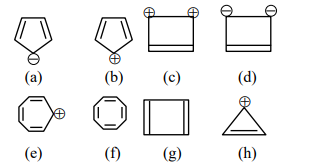
Given: The structures (a) to (h) shown in the figure.
Find: Which option correctly designates them as aromatic or not aromatic.
To determine aromaticity, check these conditions one by one:
- The molecule must be cyclic.
- The molecule must be planar.
- The molecule must be fully conjugated.
- The molecule must contain (4n+2) π electrons.
The extracted solution states:
(a) Aromatic.
It is cyclic, planar, conjugated, and has 6π electrons.
(b) Not aromatic.
It has 4π electrons, so it does not satisfy Huckel's rule for aromaticity in this question's classification.
(c) Aromatic.
It is cyclic, planar, conjugated, and has 6π electrons.
(d) Aromatic.
It is cyclic, planar, conjugated, and has 6π electrons.
(e) Aromatic.
It is cyclic, planar, conjugated, and has 6π electrons.
(f) Not aromatic.
Its structure is not planar, so effective cyclic conjugation is prevented.
(g) Not aromatic.
It has 4π electrons.
(h) Aromatic.
It is classified in the provided solution under aromatic compounds.
Hence the final grouping is:
- Aromatic: (a), (c), (d), (e), (h)
- Not aromatic: (b), (f), (g)
Therefore, the correct option is D.