MCQMediumJEE 2026Aromatic Compounds & Benzene

JEE Chemistry 2026 Question with Solution

Identify A in the following reaction.
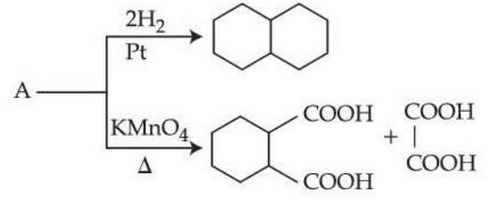
Reaction scheme showing unknown A giving decalin on hydrogenation with 2H2 and Pt, and giving a cyclohexane dicarboxylic acid plus oxalic acid on oxidation with KMnO4 and heat.
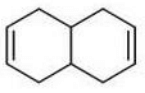
  • A
    Fused bicyclic ring structure with one double bond in the left ring and one double bond in the right ring, both at outer edges.
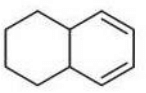
  • B
    Fused bicyclic ring structure with two double bonds located in the right ring, representing an aromaticity-reduced naphthalene isomer.
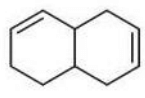
  • C
    Fused bicyclic ring structure with one double bond in the left ring and one double bond in the right ring in a different positional arrangement.
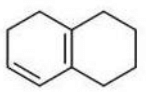
  • D
    Fused bicyclic ring structure with one double bond at the ring junction side and one double bond at the lower left outer edge.

Answer

Correct answer:B

Step-by-step solution

Standard Method

Given: The compound A on hydrogenation with 2H22H_2 / Pt\text{Pt} gives the fully saturated fused bicyclic hydrocarbon, and on oxidation with KMnO4KMnO_4 and heat gives a cyclohexane dicarboxylic acid along with oxalic acid.

Find: The correct structure of A.

Identify principle: Catalytic hydrogenation with 2H22H_2 means that A contains two π\pi bonds. Strong oxidation with KMnO4KMnO_4 cleaves the unsaturation and converts the suitable carbon fragments into carboxylic acids.

From the reaction scheme, hydrogenation produces decalin, so A must be an unsaturated fused bicyclic precursor of decalin containing exactly two double bonds.

The oxidation product shown is a cyclohexane ring bearing two adjacent COOH-COOH groups together with oxalic acid. This pattern is obtained when both double bonds are present in the same ring, because oxidative cleavage opens that ring to give a vicinal dicarboxylic acid fragment and the remaining two-carbon fragment is oxidized to oxalic acid.

Among the given structures, only option B has both double bonds in one ring of the fused bicyclic system and also consumes exactly 2H22H_2 on complete hydrogenation to decalin.

Therefore, the correct option is B.

Using the oxidation clue

Given: Oxidation is carried out with KMnO4KMnO_4 under strong conditions.

Find: Which option matches the observed cleavage products.

The provided hint states that strong oxidation converts benzylic or unsaturated carbon fragments into carboxylic acids. Here, the drawn product is not a simple monoacid; it is a dicarboxylic acid attached to a cyclohexane framework, plus oxalic acid as a separate fragment.

So we reject structures in which the two double bonds are distributed across both rings in a way that would not generate the shown pair of oxidation fragments. The structure must place the unsaturation so that one ring is preferentially cleaved while the fused skeleton still retains one cyclohexane ring in the product.

Option B matches this requirement and also fits the hydrogenation condition:

A+2H2Ptdecalin\text{A} + 2H_2 \xrightarrow{\text{Pt}} \text{decalin}

Hence, A = option B.

Common mistakes

  • Choosing a structure with two double bonds in different rings. This is wrong because the oxidation products shown require a specific cleavage pattern that keeps one cyclohexane ring intact while generating a dicarboxylic acid and oxalic acid. Match the product skeleton before deciding.

  • Ignoring the meaning of 2H22H_2. This is wrong because 2H22H_2 indicates exactly two π\pi bonds are hydrogenated. First count the total unsaturation removed, then compare with the options.

  • Using only the hydrogenation product and not the oxidation product. This is wrong because more than one unsaturated fused bicyclic compound could hydrogenate to the same saturated framework. The oxidation step is the decisive clue.

Practice more Aromatic Compounds & Benzene questions

Get unlimited AI-adaptive practice, mastery tracking, and an AI tutor that explains every step — free to start.

Related questions