
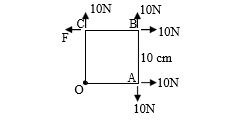
A square Lamina OABC of length is pivoted at . Forces act at Lamina as shown in figure. If Lamina remains stationary, then the magnitude of is:
- A
- B
(zero)
- C
- D
A square Lamina OABC of length is pivoted at . Forces act at Lamina as shown in figure. If Lamina remains stationary, then the magnitude of is:
(zero)
Correct answer:C
Standard Method
Given: A square lamina of side is pivoted at and remains stationary.
Find: The magnitude of .
For rotational equilibrium, the sum of torques about the pivot must be zero.
Take counter-clockwise torque as positive and clockwise torque as negative.
From the figure and the extracted working:
Applying equilibrium:
Therefore, the magnitude of the force is . The correct option is C.
Torque-by-force breakdown
Given: Side of the square is and pivot is at .
Find: Force such that the lamina remains in rotational equilibrium.
Use lever arm about for each force. Any force whose line of action passes through produces zero torque.
Clockwise torques:
Counter-clockwise torques:
Equating clockwise and counter-clockwise torques:
Hence, the required force is .
Ignoring that a force whose line of action passes through the pivot produces zero torque. Do not multiply every force by the side length; first check whether its perpendicular distance from is zero.
Using the side length as instead of converting to . Torque must be computed in SI units to keep the calculation consistent.
Taking all torques with the same sign. Clockwise and counter-clockwise torques oppose each other, so assign signs consistently before applying .
Get unlimited AI-adaptive practice, mastery tracking, and an AI tutor that explains every step — free to start.