
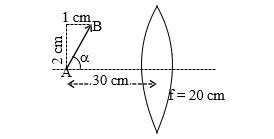
A slanted object AB is placed on one side of convex lens as shown in the diagram. The image is formed on the opposite side. Angle made by the image with principal axis is:
- A
- B
- C
- D
A slanted object AB is placed on one side of convex lens as shown in the diagram. The image is formed on the opposite side. Angle made by the image with principal axis is:
Correct answer:B
Standard Method
Given: A convex lens has . Point of the object is at on the principal axis, and point is to the right and above , so .
Find: The angle made by the image with the principal axis.
Using the thin lens formula for point :
So, the image of is .
Now for point , the object distance is . Again using the lens formula:
Slope of the image
Using magnification for point :
If the object height of point above the axis is , then
Hence,
Small-shift method
Since the object is small compared to its location, use the local magnification near . From the solution working,
and for a small horizontal shift ,
Also, the vertical size transforms as
So the image has horizontal change and vertical change , giving slope
Therefore, the image makes an angle of with the principal axis. The correct option is B.
Using the same image distance for both endpoints and is incorrect because the object is slanted, so their object distances are different. Apply the lens formula separately to each endpoint or use the small-shift relation carefully.
Ignoring the sign convention leads to the wrong orientation of the image. Here for the object on the left, and the image height comes out negative, which shows inversion. Keep signs throughout the lens and magnification formulas.
Computing only the magnified height and forgetting the horizontal shift gives the wrong angle. The angle of the image depends on both and , so use the slope .
Get unlimited AI-adaptive practice, mastery tracking, and an AI tutor that explains every step — free to start.