MCQMediumJEE 2025Torque & Angular Momentum

JEE Physics 2025 Question with Solution

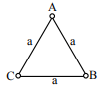
Three equal masses mm are kept at vertices (A, B, C) of an equilateral triangle of side aa in free space. At t=0t = 0, they are given an initial velocity VA=V0AC^,VB=V0BA^,VC=V0CB^.\vec{V_A} = V_0 \hat{AC}, \, \vec{V_B} = V_0 \hat{BA}, \, \vec{V_C} = V_0 \hat{CB}.

Equilateral triangle ABC with A at the top, C at the left base, B at the right base, and each side labeled a.

Here, AC^,CB^,BA^\hat{AC}, \hat{CB}, \hat{BA} are unit vectors along the edges of the triangle. If the three masses interact gravitationally, then the magnitude of the net angular momentum of the system at the point of collision is:

  • A

    12amv0\frac{1}{2} a m v_0

  • B

    3amv03 a m v_0

  • C

    32amv0\frac{\sqrt{3}}{2} a m v_0

  • D

    32amv0\frac{3}{2} a m v_0

Answer

Correct answer:C

Step-by-step solution

Standard Method

Given: Three equal masses mm are placed at the vertices of an equilateral triangle of side aa. Their initial velocities are along the sides as given. By symmetry, the particles move toward the centroid and collide there.

Find: The magnitude of the net angular momentum of the system at the point of collision.

Angular momentum of the system is conserved because the gravitational interaction is internal and central. So it is enough to calculate the initial angular momentum about the center of mass.

For an equilateral triangle of side aa, the distance of each vertex from the centroid is

r=a3r = \frac{a}{\sqrt{3}}

Each velocity is along a side, and the angle between the radius vector from centroid to a vertex and the corresponding velocity is 3030^\circ. Therefore the perpendicular distance from the centroid to the line of motion is

r=rsin30=a312=a23r_\perp = r \sin 30^\circ = \frac{a}{\sqrt{3}} \cdot \frac{1}{2} = \frac{a}{2\sqrt{3}}

So angular momentum of one particle about the centroid is

L1=mV0r=mV0a23L_1 = m V_0 r_\perp = m V_0 \frac{a}{2\sqrt{3}}

All three angular momenta are in the same sense, hence

Lnet=3L1=3×mV0a23=32amV0L_{\text{net}} = 3L_1 = 3 \times m V_0 \frac{a}{2\sqrt{3}} = \frac{\sqrt{3}}{2} a m V_0

Therefore, the magnitude of the net angular momentum at collision is 32amV0\frac{\sqrt{3}}{2} a m V_0. The correct option is C.

Using conservation of angular momentum with geometry

Given: The three masses start from the vertices of an equilateral triangle and interact only through mutual gravitation.

Find: Net angular momentum when they collide.

Because the forces are internal, the total torque about the center of mass is zero. Hence total angular momentum about the center of mass remains constant throughout the motion, including at collision.

The center of mass of three equal masses at the vertices of an equilateral triangle is the centroid. Its distance from each vertex is

r=33a=a3r = \frac{\sqrt{3}}{3}a = \frac{a}{\sqrt{3}}

Now consider one particle. Its speed is V0V_0 and its velocity is directed along a side of the triangle. The angle between the radius from centroid to the vertex and that side is 3030^\circ, so only the component perpendicular to the radius contributes:

V=V0sin30=V02V_\perp = V_0 \sin 30^\circ = \frac{V_0}{2}

Thus the angular momentum of one mass is

L1=mrV=ma3V02L_1 = m r V_\perp = m \cdot \frac{a}{\sqrt{3}} \cdot \frac{V_0}{2}

Therefore,

L1=amV023L_1 = \frac{a m V_0}{2\sqrt{3}}

For three identical masses, these contributions add:

Lnet=3amV023=32amV0L_{\text{net}} = 3 \cdot \frac{a m V_0}{2\sqrt{3}} = \frac{\sqrt{3}}{2} a m V_0

Hence, the net angular momentum at the point of collision is 32amV0\frac{\sqrt{3}}{2} a m V_0.

Common mistakes

  • Using L=mvrL = mvr directly for each particle without checking the angle between r\vec r and v\vec v. This is wrong because angular momentum depends on the perpendicular component only. Use L=mrvsinθL = mrv\sin\theta or the perpendicular distance to the line of motion instead.

  • Taking the distance from a vertex to the centroid as a2\frac{a}{2} or the altitude itself. This is wrong because for an equilateral triangle the centroid is at distance a3\frac{a}{\sqrt{3}} from each vertex. Use the centroid geometry carefully.

  • Assuming the angular momentum at collision is zero because the particles meet at one point. This is wrong because angular momentum is conserved and need not vanish at collision. Evaluate the initial angular momentum about the center of mass.

Practice more Torque & Angular Momentum questions

Get unlimited AI-adaptive practice, mastery tracking, and an AI tutor that explains every step — free to start.

Related questions