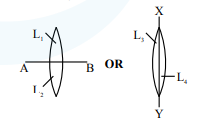
Two identical symmetric double convex lenses of focal length are cut into two equal parts by the plane and by the plane as shown in the figure respectively. The ratio of focal lengths of lenses and is:
- A
- B
- C
- D
Two identical symmetric double convex lenses of focal length are cut into two equal parts by the plane and by the plane as shown in the figure respectively. The ratio of focal lengths of lenses and is:

Correct answer:D
Standard Method
Given: Two identical symmetric double convex lenses each have focal length . Lens parts are obtained by cutting one lens by plane , while are obtained by cutting the other lens by plane .
Find: The ratio of focal lengths of and .
When a lens is cut by a plane passing through the principal axis as in the cut, each part retains the same radii of curvature of the original lens. Therefore the focal length of remains unchanged:
When the lens is cut by the plane, the symmetric double convex lens behaves like a plano-convex part for each half, so its power becomes half of the original. Hence the new focal length becomes double:
Since ,
Therefore,
Now,
Therefore, the ratio of focal lengths of and is . The correct option is D.
Using lens power idea
Given: Original focal length of each symmetric double convex lens is .
Find: .
Use the fact that lens power is
For the lens cut by plane , the aperture is reduced but the curvatures are unchanged, so the focal length does not change:
For the lens cut by plane , one curved surface of each half remains effective with half the original optical power. Hence,
This gives
So,
Therefore, the correct option is D.
Assuming that cutting a lens always halves its focal length is incorrect. Cutting parallel to the principal axis mainly reduces aperture, not curvature, so the focal length of remains .
Confusing focal length with power leads to the wrong conclusion. If power becomes half, focal length becomes double because .
Treating both types of cuts as equivalent is wrong. The cut and the cut change the optical behavior differently, so and do not have the same focal length.
Get unlimited AI-adaptive practice, mastery tracking, and an AI tutor that explains every step — free to start.