
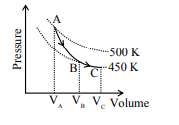
A poly-atomic molecule (, , where is gas constant) goes from phase space point A () to point B () to point C (). A to B is an adiabatic path and B to C is an isothermal path. The net heat absorbed per unit mole by the system is:
- A
- B
- C
- D
A poly-atomic molecule (, , where is gas constant) goes from phase space point A () to point B () to point C (). A to B is an adiabatic path and B to C is an isothermal path. The net heat absorbed per unit mole by the system is:
Correct answer:B
Standard Method
Given: The process A to B is adiabatic and B to C is isothermal. We need the net heat absorbed per mole.
Find: Net heat absorbed by the system per mole.
For the total process,
For the adiabatic path A to B,
For the isothermal path B to C, heat absorbed equals the work done:
From the given solution working,
Hence,
Therefore, the net heat absorbed per mole is and the correct option is B.
Using process-wise heat transfer
Given: One segment is adiabatic and the other is isothermal.
Find: Which segment contributes to heat absorption.
So the total heat absorbed over the complete path A \to B \to C is . Hence, the correct option is B.
Assuming the adiabatic path also contributes heat transfer. This is wrong because by definition an adiabatic process has . Only the isothermal segment contributes to the net heat absorbed here.
Using the internal energy change formula for the isothermal segment. This is wrong for an ideal gas in an isothermal process because , so the heat absorbed equals the work done, not .
Substituting the wrong volume ratio in the logarithm, such as instead of . This changes the sign of heat. For expansion from B to C, use final volume over initial volume.
Get unlimited AI-adaptive practice, mastery tracking, and an AI tutor that explains every step — free to start.