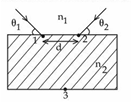
Two light beams fall on a transparent material block at point 1 and 2 with angle θ1 and θ2, respectively, as shown in the figure. After refraction, the beams intersect at point 3 which is exactly on the interface at the other end of the block. Given: the distance between 1 and 2, d=34cm and θ1=θ2=cos−1(2n1n2), where n2 is the refractive index of the block and n1 is the refractive index of the outside medium, then the thickness of the block is _____ cm.
A
1cm
B
2cm
C
3cm
D
4cm
Answer
Correct answer:C
Step-by-step solution
Standard Method
Given: Two rays are incident on the top surface at points 1 and 2 with θ1=θ2=cos−1(2n1n2) and d=34cm. The refracted rays meet at point 3 on the lower face.
Find: The thickness of the block.
Use Snell's law at the upper surface:
n1sinθ=n2sinr
where θ=cos−1(2n1n2).
So,
cosθ=2n1n2
and hence
sinθ=1−cos2θ=1−(2n1n2)2
the solution states that using Snell's law together with the geometry of the refracted beams gives the thickness of the block as 3cm.
Thus, the correct option is C.
Common mistakes
Using only Snell's law and ignoring the geometry of the two refracted rays. Snell's law gives the refracted angle, but the thickness comes from how the two rays meet at point 3. Always combine refraction with the ray-path geometry.
Confusing the angle of incidence with the angle of refraction. The given θ1 and θ2 are outside the block, whereas the internal angles are different. First apply Snell's law, then use the internal geometry.
Substituting cosθ directly into Snell's law instead of using sinθ. Since Snell's law involves sine of the angle, convert the given cosine form carefully before proceeding.
Practice more Refraction & Lenses questions
Get unlimited AI-adaptive practice, mastery tracking, and an AI tutor that explains every step — free to start.