MCQEasyJEE 2025Refraction & Lenses

JEE Physics 2025 Question with Solution

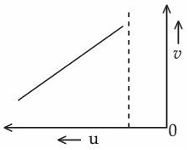
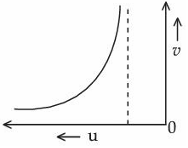
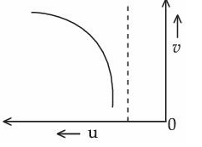
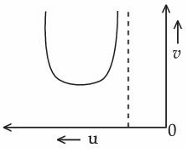
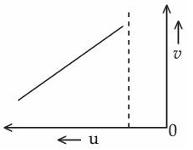
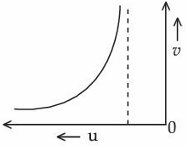
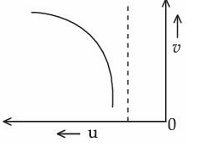
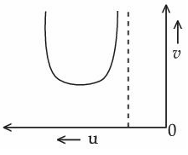
Let uu and vv be the distances of the object and the image from a lens of focal length ff. The correct graphical representation of uu and vv for a convex lens when u>f|u| > f, is:

Graph with horizontal axis labeled u pointing left, vertical axis labeled v upward, and a straight increasing line before a dashed vertical line near the origin.Graph with horizontal axis labeled u pointing left, vertical axis labeled v upward, and an increasing inverse-like curve approaching a dashed vertical line near the origin.Graph with horizontal axis labeled u pointing left, vertical axis labeled v upward, and a decreasing curved branch approaching a dashed vertical line near the origin.Graph with horizontal axis labeled u pointing left, vertical axis labeled v upward, and a U-shaped curve placed before a dashed vertical line near the origin.
  • A
    Graph with horizontal axis labeled u pointing left, vertical axis labeled v upward, and a straight increasing line before a dashed vertical line near the origin.
  • B
    Graph with horizontal axis labeled u pointing left, vertical axis labeled v upward, and an increasing inverse-like curve approaching a dashed vertical line near the origin.
  • C
    Graph with horizontal axis labeled u pointing left, vertical axis labeled v upward, and a decreasing curved branch approaching a dashed vertical line near the origin.
  • D
    Graph with horizontal axis labeled u pointing left, vertical axis labeled v upward, and a U-shaped curve placed before a dashed vertical line near the origin.

Answer

Correct answer:B

Step-by-step solution

Standard Method

Given: A convex lens with object distance uu, image distance vv, and focal length ff, with u>f|u| > f.

Find: The correct graph relating uu and vv.

Using the lens formula:

1f=1v+1u\frac{1}{f} = \frac{1}{v} + \frac{1}{u}

Rearranging,

1v=1f1u\frac{1}{v} = \frac{1}{f} - \frac{1}{u}

Hence,

v=fuufv = \frac{fu}{u-f}

This is not a linear relation. It represents a hyperbolic or inverse-type relation between uu and vv.

As uu varies for u>f|u| > f, the denominator ufu-f controls the rapid change in vv, so the graph is an inverse curve rather than a straight line or a parabola.

Therefore, the correct option is B.

Detailed Graph Interpretation

Given: The relation between object distance uu and image distance vv for a convex lens.

Find: Which of the four graphs correctly represents the variation when u>f|u| > f.

The lens formula is:

1f=1v+1u\frac{1}{f} = \frac{1}{v} + \frac{1}{u}

Multiplying through and rearranging gives:

uv=f(u+v)uv = f(u+v)

or

v=ufufv = \frac{uf}{u-f}

This equation shows that vv depends on uu through a rational expression, so the graph is a rectangular-hyperbola-type curve.

Thus:

  • it is not a straight line,
  • it is not a decreasing branch of the wrong sense,
  • it is not a U-shaped curve.

So the inverse graph shown in the second figure matches the required relation. Therefore, the correct option is B.

Common mistakes

  • Assuming the relation between uu and vv is linear because both are distances is incorrect. The lens formula gives a rational relation, so the graph must be hyperbolic. Use v=fuufv = \frac{fu}{u-f} before judging the graph.

  • Ignoring the condition u>f|u| > f leads to choosing a graph that does not match the physical image formation region. First apply the focal-length restriction, then study the behavior of the curve.

  • Confusing sign convention with graphical shape is a conceptual error. Even though signs matter in optics, the functional dependence here still comes from the lens equation, so identify the algebraic form of the curve first.

Practice more Refraction & Lenses questions

Get unlimited AI-adaptive practice, mastery tracking, and an AI tutor that explains every step — free to start.

Related questions