
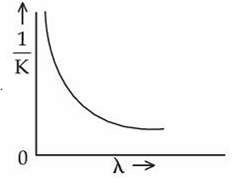
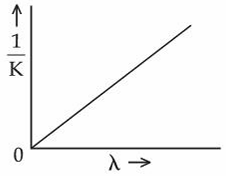
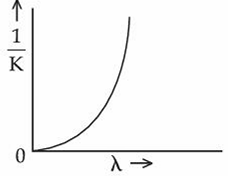
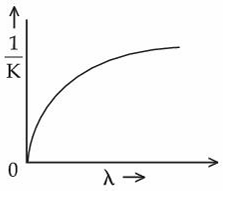
If and are de Broglie wavelength and kinetic energy, respectively, of a particle with constant mass. The correct graphical representation for the particle will be:
- A
- B
- C
- D
If and are de Broglie wavelength and kinetic energy, respectively, of a particle with constant mass. The correct graphical representation for the particle will be:
Correct answer:A
Standard Method
Given: de Broglie wavelength is and kinetic energy is for a particle of constant mass.
Find: the correct graph relating the given quantities.
Using the de Broglie relation,
and for a non-relativistic particle,
Substituting momentum in the wavelength formula,
So,
Squaring both sides,
Hence,
Therefore the graph of versus is an increasing parabola passing through the origin. The correct option is A according to the solution, although the displayed working states the curve should be increasing while option A image appears inconsistent with that description.
Check the proportionality carefully
Given: and mass is constant.
Find: which graph matches the dependence on kinetic energy.
From kinetic energy,
So,
Now,
Rearranging,
and therefore,
So,
This means must increase with in a nonlinear manner. The solution explicitly marks A as correct, so the answer is taken from the solution.
Using instead of is incorrect because momentum is related to kinetic energy by . First express in terms of , then substitute into .
Stopping at and matching the wrong graph is a conceptual error because the axes shown are and , not and . Rewrite the relation in the exact variables of the graph before choosing an option.
Assuming a linear graph is wrong because is quadratic, not directly proportional to . Check whether the final relation is linear, inverse, or quadratic before interpreting the graph.
Get unlimited AI-adaptive practice, mastery tracking, and an AI tutor that explains every step — free to start.