MCQMediumJEE 2025Valence Bond Theory

JEE Chemistry 2025 Question with Solution

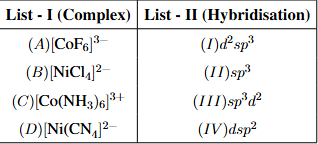
Match List - I with List - II. List - I (Complex)List - II (Hybridisation)\begin{array}{|c|c|} \hline \textbf{List - I (Complex)} & \textbf{List - II (Hybridisation)}\end{array}

Table showing List I complexes and List II hybridisations for matching in coordination chemistry, with four complexes and four hybridisation types.

Choose the correct answer from the options given below:

  • A

    (A)-(I), (B)-(II), (C)-(III), (D)-(IV)

  • B

    (A)-(III), (B)-(IV), (C)-(I), (D)-(II)

  • C

    (A)-(III), (B)-(II), (C)-(I), (D)-(IV)

  • D

    (A)-(I), (B)-(II), (C)-(III), (D)-(IV)

Answer

Correct answer:C

Step-by-step solution

Standard Method

Given: We have to match the complexes in List–I with their hybridisations in List–II using valence bond theory.

Find: The correct correspondence among (I) d2sp3d^2sp^3, (II) sp3sp^3, (III) sp3d2sp^3d^2, and (IV) dsp2dsp^2.

For (A) [CoF₆]³⁻:

  • Oxidation state of Co is +3+3.
  • F⁻ is a weak field ligand, so pairing does not occur.
  • This forms an outer orbital octahedral complex. Therefore, hybridisation is sp3d2sp^3d^2. So, (A) \to (III).

For (B) [NiCl₄]²⁻:

  • Oxidation state of Ni is +2+2.
  • Cl⁻ is a weak field ligand, so pairing does not occur.
  • The complex is tetrahedral. Therefore, hybridisation is sp3sp^3. So, (B) \to (II).

For (C) [Co(NH₃)₆]³⁺:

  • Oxidation state of Co is +3+3.
  • NH₃ acts as a strong ligand here, so pairing occurs.
  • This gives an inner orbital octahedral complex. Therefore, hybridisation is d2sp3d^2sp^3. So, (C) \to (I).

For (D) [Ni(CN)₄]²⁻:

  • Oxidation state of Ni is +2+2.
  • CN⁻ is a strong field ligand, so pairing occurs.
  • The complex becomes square planar. Therefore, hybridisation is dsp2dsp^2. So, (D) \to (IV).

Thus the final matching is:

(A)(III)(B)(II)(C)(I)(D)(IV)\begin{aligned} (A) &\to (III) \\ (B) &\to (II) \\ (C) &\to (I) \\ (D) &\to (IV) \end{aligned}

Therefore, the correct option is C.

Ligand Strength and Geometry Analysis

Given: The complexes are [CoF₆]³⁻, [NiCl₄]²⁻, [Co(NH₃)₆]³⁺, and [Ni(CN)₄]²⁻.

Find: Match each complex with the correct hybridisation by examining ligand strength, electron pairing, and geometry.

Weak field ligands such as F⁻ and Cl⁻ generally do not cause pairing in the dd orbitals, so outer orbital complexes or tetrahedral arrangements are preferred. Strong field ligands such as NH₃ and CN⁻ can cause pairing, allowing inner orbital hybridisation.

Applying this:

  1. [CoF₆]³⁻ is octahedral with weak ligand F⁻, so it is outer orbital: sp3d2sp^3d^2.
  2. [NiCl₄]²⁻ with weak ligand Cl⁻ is tetrahedral: sp3sp^3.
  3. [Co(NH₃)₆]³⁺ undergoes pairing and forms an inner orbital octahedral complex: d2sp3d^2sp^3.
  4. [Ni(CN)₄]²⁻ with strong ligand CN⁻ forms a square planar complex: dsp2dsp^2.

Hence the required match is (A)-(III), (B)-(II), (C)-(I), (D)-(IV), so the correct option is C.

Common mistakes

  • Assuming every octahedral complex has d2sp3d^2sp^3 hybridisation is incorrect. Weak field ligands like F⁻ may produce outer orbital octahedral complexes with sp3d2sp^3d^2 hybridisation. Always check ligand strength before deciding pairing.

  • Treating [NiCl₄]²⁻ as square planar is wrong. Cl⁻ is a weak field ligand, so Ni(II) usually forms a tetrahedral complex with sp3sp^3 hybridisation. Use ligand field strength and geometry together.

  • Forgetting that CN⁻ is a strong field ligand leads to the wrong hybridisation for [Ni(CN)₄]²⁻. Because pairing occurs, the complex becomes square planar with dsp2dsp^2, not tetrahedral sp3sp^3.

Practice more Valence Bond Theory questions

Get unlimited AI-adaptive practice, mastery tracking, and an AI tutor that explains every step — free to start.

Related questions