
The correct order of stability of following carbocations is:
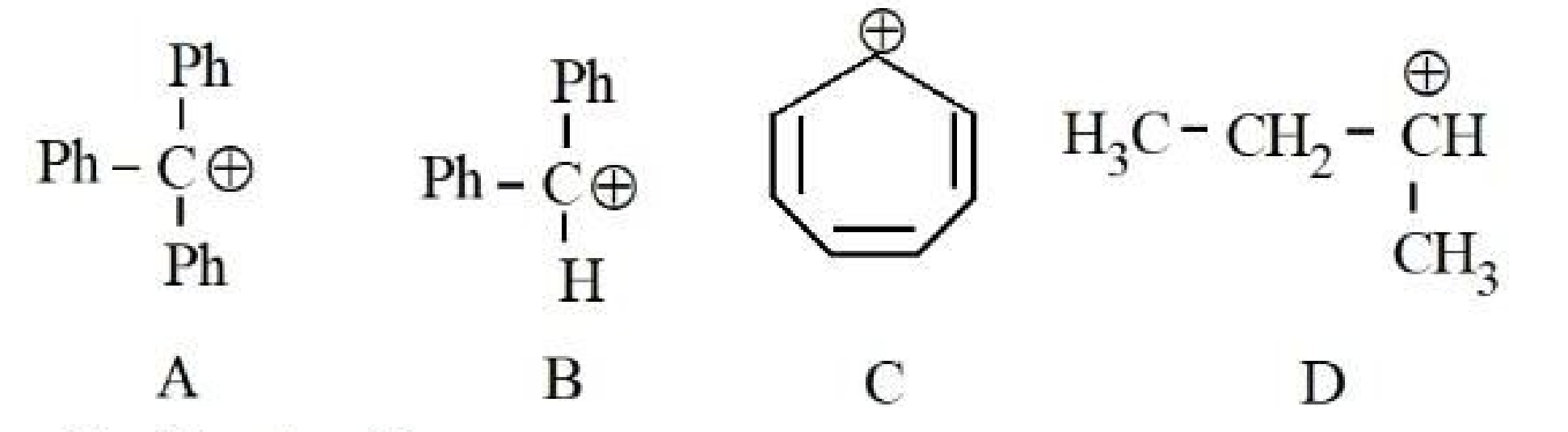
- A
C B A D
- B
A B C D
- C
B C A D
- D
C A B D
The correct order of stability of following carbocations is:
C B A D
A B C D
B C A D
C A B D
Correct answer:D
Standard Method
Given: Four carbocations A, B, C, and D are to be arranged in decreasing order of stability.
Find: The correct order of stability.
The solution text identifies:
The stability arguments stated in the solution are based on resonance, aromaticity, and inductive / hyperconjugative stabilization.
Therefore, the order obtained from the solution working is:
This matches option D.
Note: The answer key marks option B, but the extracted solution explicitly concludes . As per the solution, the correct option is D.
Why this order is correct
Given: Stability depends on how well the positive charge is dispersed.
Find: Compare the four carbocations.
C is the tropylium carbocation. Its positive charge is delocalized over the ring, and the ring has electrons, so it is aromatic. Aromatic stabilization makes it exceptionally stable.
A is the triphenyl carbocation. The positively charged carbon is attached to three phenyl groups, so resonance delocalization is extensive.
B is the diphenyl carbocation. It is also resonance-stabilized, but only by two phenyl groups, so it is less stable than A.
D is a secondary carbocation. It is stabilized mainly by alkyl effects and hyperconjugation, but it does not have the strong resonance stabilization present in A, B, or C.
Hence,
So, the correct option is D.
Placing A above C by counting phenyl rings only is incorrect. Aromatic stabilization in the tropylium ion is stronger than ordinary benzylic resonance. Always check for aromaticity before comparing only resonance contributors.
Assuming B is more stable than A is wrong because both are resonance-stabilized, but A has one extra phenyl ring for delocalization. Compare the extent of resonance stabilization carefully.
Treating D as comparable to the aryl-stabilized carbocations is incorrect. A secondary carbocation is stabilized mainly by hyperconjugation and inductive effects, which are much weaker than strong resonance or aromatic stabilization. Distinguish hyperconjugation from resonance.
Get unlimited AI-adaptive practice, mastery tracking, and an AI tutor that explains every step — free to start.