MCQMediumJEE 2025First Law & Internal Energy

JEE Physics 2025 Question with Solution

The magnitude of heat exchanged by a system for the given cyclic process ABC (as shown in the figure) is (in SI units):
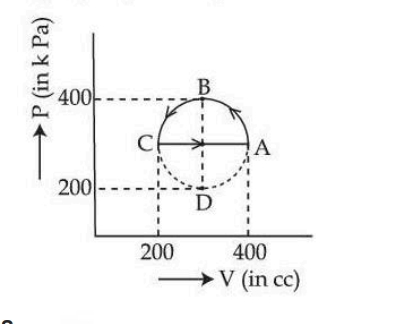
P-V diagram with pressure P in kPa on vertical axis and volume V in cc on horizontal axis, showing a circular cyclic path through points A, B, C, D centered near 300 cc and 300 kPa, with dashed lines at 200 and 400 on both axes.
  • A

    5π5\pi

  • B

    40π40\pi

  • C

    10π10\pi

  • D

    zero

Answer

Correct answer:C

Step-by-step solution

Standard Method

Given: The process ABCABC is a cyclic process on a PVP-V diagram.

Find: The magnitude of heat exchanged by the system in SI units.

For a cyclic process,

ΔU=0\Delta U = 0

so by the first law of thermodynamics,

Q=WQ = W

Thus, the magnitude of heat exchanged is equal to the area enclosed by the cycle on the PVP-V diagram.

From the figure, the path is a circle with horizontal diameter from V=200ccV = 200 \, \text{cc} to V=400ccV = 400 \, \text{cc} and vertical diameter from P=200kPaP = 200 \, \text{kPa} to P=400kPaP = 400 \, \text{kPa}.

Hence the semi-axes are:

rV=100cc=100×106m3r_V = 100 \, \text{cc} = 100 \times 10^{-6} \, \text{m}^3 rP=100kPa=100×103Par_P = 100 \, \text{kPa} = 100 \times 10^3 \, \text{Pa}

Area enclosed by the ellipse-like plot in PVP-V units is

W=πrPrVW = \pi r_P r_V

Substituting,

W=π(100×103)(100×106)W = \pi \left(100 \times 10^3\right)\left(100 \times 10^{-6}\right) W=10π  JW = 10\pi \; \text{J}

Therefore, the magnitude of heat exchanged is 10πJ10\pi \, \text{J}.

The correct option is C.

Using the enclosed area of the cyclic curve

Given: A closed cyclic process is shown on the PVP-V diagram.

Find: Magnitude of heat exchanged.

The solution states that the correct option is C. For a cyclic process, internal energy returns to its initial value, so

ΔU=0\Delta U = 0

and therefore

Q=WQ = W

The required magnitude is the area enclosed by the closed curve.

A common misread is to treat the enclosed shape as a rectangle. However, the figure shows a circular curve, so the enclosed area is not rectangular. Its horizontal and vertical diameters are each 200200 units in the plotted scales, hence each semi-axis is 100100.

So,

Area=πab=π×100kPa×100cc\text{Area} = \pi ab = \pi \times 100 \, \text{kPa} \times 100 \, \text{cc}

Convert units:

100kPa=100×103Pa100 \, \text{kPa} = 100 \times 10^3 \, \text{Pa} 100cc=100×106m3100 \, \text{cc} = 100 \times 10^{-6} \, \text{m}^3

Therefore,

W=π×100×103×100×106W = \pi \times 100 \times 10^3 \times 100 \times 10^{-6} W=10π  JW = 10\pi \; \text{J}

Hence, the magnitude of heat exchanged is 10πJ10\pi \, \text{J}.

Therefore, the correct option is C.

Note: The solution text contains inconsistent wording such as calling the figure a rectangle, but its final conclusion and option label support 10π10\pi.

Common mistakes

  • Treating the enclosed path as a rectangle is incorrect because the figure shows a circular closed curve. Use the area of the enclosed curved region, not length×breadth\text{length} \times \text{breadth} of a rectangle.

  • Forgetting that in a cyclic process ΔU=0\Delta U = 0 leads to an incorrect application of the first law. Use Q=WQ = W for the complete cycle.

  • Missing unit conversion from kPa\text{kPa} and cc\text{cc} to SI units gives the wrong numerical value. Convert pressure to Pa\text{Pa} and volume to m3\text{m}^3 before evaluating the work.

Practice more First Law & Internal Energy questions

Get unlimited AI-adaptive practice, mastery tracking, and an AI tutor that explains every step — free to start.

Related questions