NVAMediumJEE 2025Integrated Rate Laws

JEE Chemistry 2025 Question with Solution

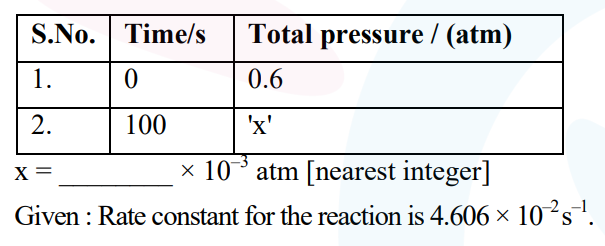
For the thermal decomposition of N2O5(g)N_2O_5(g) at constant volume, the following table can be formed, for the reaction mentioned below: 2N2O5(g)2N2O4(g)+O2(g)2 N_2O_5(g) \rightarrow 2 N_2O_4(g) + O_2(g) Given: Rate constant for the reaction is 4.606×10²s14.606 \times 10^{-2} \, s^{-1}.

A table with columns S.No., Time/s, and Total pressure /(atm), showing at 0 s pressure 0.6 atm and at 100 s pressure x, followed by x equals blank times 10 to the power minus 3 atm nearest integer, and the given rate constant.

Answer

Correct answer:897

Step-by-step solution

Standard Method

Given: Initial total pressure at t=0t = 0 is 0.6atm0.6 \, \text{atm}, rate constant k=4.606×10²s1k = 4.606 \times 10^{-2} \, s^{-1}, and time t=100st = 100 \, \text{s}.

Find: The value of xx in total pressure at 100s100 \, \text{s} for the reaction

2N2O5(g)2N2O4(g)+O2(g)2N_2O_5(g) \rightarrow 2N_2O_4(g) + O_2(g)

For a first-order reaction,

k=1tln(P0Pt)k = \frac{1}{t} \ln\left(\frac{P_0}{P_t}\right)

where P0P_0 is the initial pressure of N2O5N_2O_5 and PtP_t is its pressure at time tt.

Substituting the given values,

4.606×102=1100ln(0.6Pt)4.606 \times 10^{-2} = \frac{1}{100} \ln\left(\frac{0.6}{P_t}\right) ln(0.6Pt)=4.606\ln\left(\frac{0.6}{P_t}\right) = 4.606 0.6Pt=e4.606100\frac{0.6}{P_t} = e^{4.606} \approx 100 Pt=0.6100=0.006atmP_t = \frac{0.6}{100} = 0.006 \, \text{atm}

Let the pressure of O2O_2 formed be pp. Then from stoichiometry, the decrease in pressure of N2O5N_2O_5 is 2p2p.

So,

0.62p=0.0060.6 - 2p = 0.006 2p=0.5942p = 0.594 p=0.297p = 0.297

At time tt, total pressure is

Ptotal=(0.62p)+2p+p=0.6+pP_{\text{total}} = (0.6 - 2p) + 2p + p = 0.6 + p Ptotal=0.6+0.297=0.897atmP_{\text{total}} = 0.6 + 0.297 = 0.897 \, \text{atm}

Therefore,

x=897×103atmx = 897 \times 10^{-3} \, \text{atm}

So the required nearest integer is 897.

The solution shows a discrepancy with the answer key, but the worked solution gives 897.

Pressure Stoichiometry Method

Given: Initially only N2O5N_2O_5 is present with total pressure 0.6atm0.6 \, \text{atm}.

Find: Total pressure after 100s100 \, \text{s}.

Let pressure of O2O_2 formed after 100s100 \, \text{s} be pp. From

2N2O5(g)2N2O4(g)+O2(g)2N_2O_5(g) \rightarrow 2N_2O_4(g) + O_2(g)

if O2O_2 formed is pp, then:

  • pressure decrease of N2O5N_2O_5 is 2p2p
  • pressure increase of N2O4N_2O_4 is 2p2p

Hence pressure of N2O5N_2O_5 left is 0.62p0.6 - 2p.

Using first-order kinetics,

k=1tln([N2O5]0[N2O5]t)=1tln(0.60.62p)k = \frac{1}{t} \ln\left(\frac{[N_2O_5]_0}{[N_2O_5]_t}\right) = \frac{1}{t} \ln\left(\frac{0.6}{0.6 - 2p}\right)

Substitute the values:

4.606×102=1100ln(0.60.62p)4.606 \times 10^{-2} = \frac{1}{100} \ln\left(\frac{0.6}{0.6 - 2p}\right) ln(0.60.62p)=4.606\ln\left(\frac{0.6}{0.6 - 2p}\right) = 4.606 0.60.62p=e4.606100\frac{0.6}{0.6 - 2p} = e^{4.606} \approx 100 0.62p=0.6100=0.0060.6 - 2p = \frac{0.6}{100} = 0.006 2p=0.5942p = 0.594 p=0.297p = 0.297

Now total pressure at time tt is

P(t)=(0.62p)+2p+p=0.6+pP(t) = (0.6 - 2p) + 2p + p = 0.6 + p P(t)=0.6+0.297=0.897atmP(t) = 0.6 + 0.297 = 0.897 \, \text{atm}

Therefore, x=897×103atmx = 897 \times 10^{-3} \, \text{atm} and the numerical answer is 897.

Common mistakes

  • Using total pressure directly in the first-order formula is incorrect because the kinetic equation applies to the reactant N2O5N_2O_5, not the total pressure. First find the remaining partial pressure of N2O5N_2O_5, then use stoichiometry to get total pressure.

  • Ignoring stoichiometric pressure changes leads to a wrong total pressure. For every 11 mole of O2O_2 formed, 22 moles of N2O5N_2O_5 disappear and 22 moles of N2O4N_2O_4 appear, so the pressure relations must follow the reaction coefficients.

  • Taking the answer key as 900 by rounding too early is incorrect. The worked value is 0.897atm=897×103atm0.897 \, \text{atm} = 897 \times 10^{-3} \, \text{atm}, so the nearest integer asked in the table format is 897, not 900.

Practice more Integrated Rate Laws questions

Get unlimited AI-adaptive practice, mastery tracking, and an AI tutor that explains every step — free to start.

Related questions