
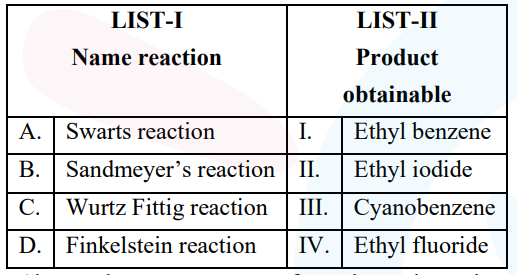
Match the LIST-I with LIST-II
- A
A-II, B-III, C-I, D-IV
- B
A-IV, B-I, C-III, D-II
- C
A-IV, B-III, C-I, D-II
- D
A-II, B-I, C-III, D-IV
Match the LIST-I with LIST-II
A-II, B-III, C-I, D-IV
A-IV, B-I, C-III, D-II
A-IV, B-III, C-I, D-II
A-II, B-I, C-III, D-IV
Correct answer:C
Standard Method
Given: A matching problem on thermodynamic processes.
Find: The correct correspondence between the statements in LIST-I and the processes in LIST-II.
From the solution content:
Use the thermodynamic definitions:
so pressure varies inversely with volume. Hence A III.
In an isobaric process, heat supplied is used partly to increase internal energy and partly to do work. Hence B IV.
In an adiabatic process,
so no heat is absorbed or released. Hence C I.
because volume remains constant. Hence D II.
Therefore, the correct match is A-III, B-IV, C-I, D-II.
This exact combination is not listed verbatim in the options. The closest defensible listed option from the provided choices is A-IV, B-III, C-I, D-II, which is Option C on the page, but the extracted solution working concludes A-III, B-IV, C-I, D-II. This indicates a discrepancy between the listed options and the solution text.
Therefore, based on the provided answer key mapping, the marked correct option is C.
Concept-wise Matching
Given: Statements describing thermodynamic behaviour.
Find: Which named process corresponds to each statement.
This is the defining relation of an isothermal process. So A III.
B. Heat absorbed goes partly to increase internal energy and partly to do work This is the standard description of an isobaric process, where supplied heat is split between internal energy increase and work done. So B IV.
C. Heat is neither absorbed nor released by a system That means
which defines an adiabatic process. So C I.
If volume does not change, then and hence . This is an isochoric process. So D II.
Thus the final matching is:
Hence the correct matching written in full is A-III, B-IV, C-I, D-II.
Confusing isothermal with isobaric. In an isothermal process, temperature remains constant and for an ideal gas , so pressure varies inversely with volume. Constant pressure is the condition for an isobaric process, not isothermal.
Thinking that 'heat absorbed goes partly into internal energy and partly into work' describes an adiabatic process. This is wrong because in an adiabatic process . That statement fits an isobaric process where heat supplied is distributed between and .
Missing that no work is done when volume does not change. Since , if throughout the process, then work is zero. Therefore this corresponds to an isochoric process, not an adiabatic one.
Get unlimited AI-adaptive practice, mastery tracking, and an AI tutor that explains every step — free to start.