MCQEasyJEE 2025Electronic Effects (Inductive, Resonance, Hyperconjugation)

JEE Chemistry 2025 Question with Solution

The most stable carbocation from the following is:
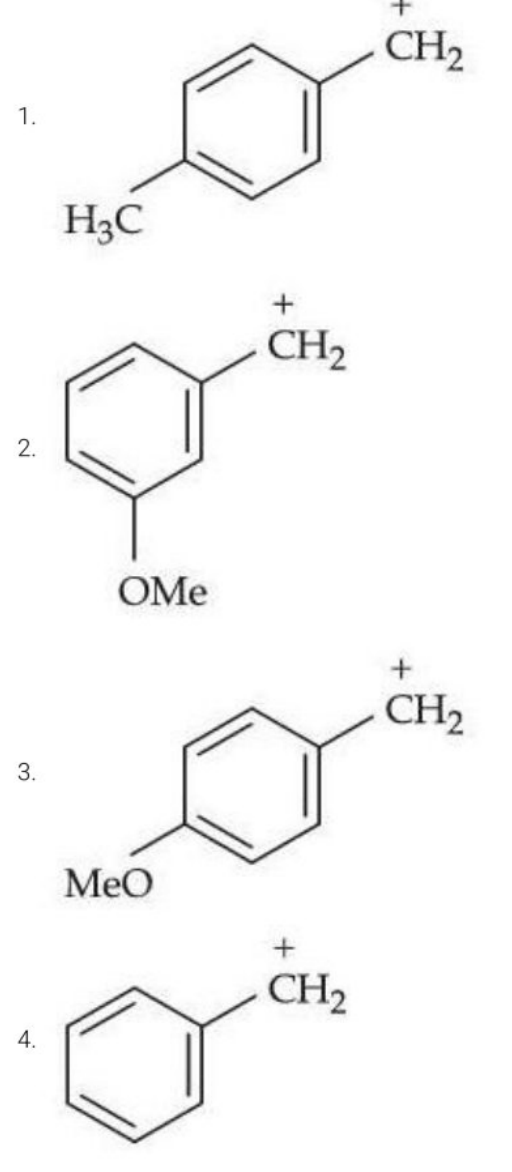
Four benzyl carbocation structures labeled 1 to 4, showing benzene rings substituted with methyl or methoxy groups at different positions relative to a CH2 positive charge.
  • A

    11

  • B

    22

  • C

    33

  • D

    44

Answer

Correct answer:D

Step-by-step solution

Standard Method

Given: Four carbocations are shown.

Find: The most stable carbocation.

Carbocation stability increases when the positive charge is stabilized by resonance. A methoxy group -OCH3\text{-OCH}_3 donates electron density by resonance, while a methyl group mainly provides weaker hyperconjugative or inductive effects.

From the solution, the benzylic carbocation with the most effective resonance stabilization is the structure corresponding to option D.

Therefore, the correct option is D.

Resonance Comparison

Given: The structures differ by substituents on the benzene ring attached to a benzylic carbocation.

Find: Which substituted benzylic carbocation is most stable.

The solution states that carbocation stability depends on substitution, hyperconjugation, and especially resonance.

  • Primary carbocations are less stable.
  • Secondary carbocations are more stable than primary carbocations.
  • Tertiary carbocations are more stable due to greater hyperconjugation.
  • Resonance-stabilized carbocations can be more stable because the positive charge is delocalized.

Among the given structures, the methoxy-substituted benzylic carbocation is identified in the solution as the most resonance-stabilized species.

Hence, the most stable carbocation is option D.

Common mistakes

  • Focusing only on the degree of substitution of the carbocation is incorrect because benzylic resonance stabilization can dominate. Compare resonance effects before applying the primary-secondary-tertiary rule.

  • Treating -OCH3\text{-OCH}_3 as only an electron-withdrawing group is incorrect here. Although oxygen is electronegative, methoxy donates electron density by resonance to the aromatic system, which stabilizes the carbocation.

Practice more Electronic Effects (Inductive, Resonance, Hyperconjugation) questions

Get unlimited AI-adaptive practice, mastery tracking, and an AI tutor that explains every step — free to start.

Related questions