MCQEasyJEE 2025Refraction & Lenses

JEE Physics 2025 Question with Solution

A symmetric thin biconvex lens is cut into four equal parts by two planes AB and CD as shown in the figure. If the power of the original lens is 4D4\,\text{D}, then the power of a part of the divided lens is:
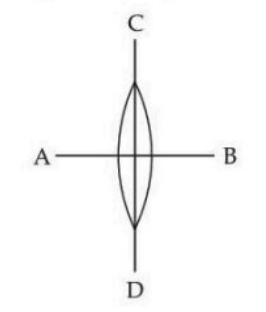
A symmetric thin biconvex lens is shown vertically with a horizontal line AB through the center and a vertical line CD through the lens, dividing it into four equal parts.
  • A

    D\text{D}

  • B

    8D8\,\text{D}

  • C

    2D2\,\text{D}

  • D

    4D4\,\text{D}

Answer

Correct answer:C

Step-by-step solution

Standard Method

Given: The power of the original lens is 4D4\,\text{D}.

Find: The power of one part when the symmetric thin biconvex lens is cut into four equal parts by planes ABAB and CDCD.

When the lens is divided symmetrically, the focal length of each part becomes double of the original lens. Since power is inversely proportional to focal length,

P=1fP = \frac{1}{f}

so if focal length doubles, power becomes half.

Therefore,

Ppart=Poriginal2=4D2=2DP_{\text{part}} = \frac{P_{\text{original}}}{2} = \frac{4\,\text{D}}{2} = 2\,\text{D}

Hence, the power of each part is 2D2\,\text{D}.

Therefore, the correct option is C.

Using the power relation

Given: Original lens power is 4D4\,\text{D}.

Find: Power of one of the four equal parts.

Use the lens power relation:

P=1fP = \frac{1}{f}

When the symmetric lens is cut into equal parts as shown, each part has doubled focal length compared with the original lens.

So,

fpart=2foriginalf_{\text{part}} = 2f_{\text{original}}

Hence,

Ppart=1fpart=12foriginal=12PoriginalP_{\text{part}} = \frac{1}{f_{\text{part}}} = \frac{1}{2f_{\text{original}}} = \frac{1}{2}P_{\text{original}}

Substituting Poriginal=4DP_{\text{original}} = 4\,\text{D},

Ppart=12×4D=2DP_{\text{part}} = \frac{1}{2} \times 4\,\text{D} = 2\,\text{D}

Thus, the power of one part is 2D2\,\text{D}.

Common mistakes

  • Assuming that power becomes one-fourth because the lens is cut into four equal parts. This is wrong because lens power does not scale directly with area. Use the focal length change given by the symmetric division, then apply P=1fP = \frac{1}{f}.

  • Confusing reduced aperture with reduced power. Cutting the lens reduces the amount of light transmitted, but aperture alone does not directly determine power. Focus on how the effective focal length changes for the divided part.

Practice more Refraction & Lenses questions

Get unlimited AI-adaptive practice, mastery tracking, and an AI tutor that explains every step — free to start.

Related questions