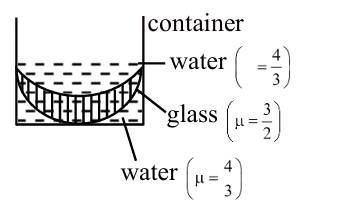
In the diagram given below, there are three lenses formed. Considering negligible thickness of each of them as compared to and , i.e., the radii of curvature for upper and lower surfaces of the glass lens, the power of the combination is:
- A
- B
- C
- D
In the diagram given below, there are three lenses formed. Considering negligible thickness of each of them as compared to and , i.e., the radii of curvature for upper and lower surfaces of the glass lens, the power of the combination is:

Correct answer:B
Standard Method
Given: Three thin lenses are formed by the curved glass sheet. The radii of curvature of the upper and lower surfaces are and respectively. The surrounding medium is water and the glass refractive index is such that the individual powers shown in the solution are added.
Find: The equivalent power of the combination.
For thin lenses in contact, the equivalent power is the algebraic sum of the individual powers:
From the given working,
So,
For the middle lens,
Hence,
For the third lens,
Therefore,
Now add the three powers:
Simplifying,
Therefore, the equivalent power is , so the correct option is B.
Using lens-maker sign convention
Given: Three thin lenses are formed from the same arrangement, with magnitudes of curvatures and .
Find: The total power using sign convention.
Use the thin-lens power formula for each part:
According to the provided explanation, the three lens powers combine with signs determined by the orientations of the curved surfaces. Using the refractive indices in the figure and the shown algebra, the final sum becomes:
Hence the combination is diverging for the orientation shown, and the correct option is B.
Using the powers of the three lenses with the same sign is incorrect because each surface orientation changes the sign of the corresponding radius. Use the proper sign convention for each thin lens before adding their powers.
Treating the combination as a single ordinary glass lens in air is wrong because the surrounding medium is water, not air. The individual powers must be written using the refractive-index contrast relevant to each lens region.
Dropping the algebraic sum and adding only magnitudes of and leads to the wrong option. Preserve the subtraction exactly as it appears after simplification.
Get unlimited AI-adaptive practice, mastery tracking, and an AI tutor that explains every step — free to start.