
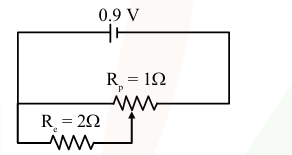
Sliding contact of a potentiometer is in the middle of the potentiometer wire having resistance as shown in the figure.
An external resistance of is connected via the sliding contact.
The current is :
- A
- B
- C
- D
Sliding contact of a potentiometer is in the middle of the potentiometer wire having resistance as shown in the figure.
An external resistance of is connected via the sliding contact.
The current is :
Correct answer:C
Standard Method
Given: The potentiometer wire has resistance and the sliding contact is at the middle, so each half has resistance . The external resistance is and the source voltage is .
Find: The current .
The circuit can be considered as
Now, the current is
Therefore, the current is and the correct option is C.
Stepwise Circuit Simplification
Given: The sliding contact is at the midpoint of the potentiometer wire, so the wire is divided into two equal resistances of each. Also, .
Find: The current through the circuit.
Identify the combination: One half of the potentiometer wire is in series with the parallel combination of the other half and the external resistor.
So,
Now calculate the parallel part:
Hence,
Using Ohm's law with source voltage ,
Thus, the current is .
The second provided approach shows a different intermediate equivalent resistance, but it still concludes the current to be . The option consistent with the stated correct answer on the solution is C.
Treating the full potentiometer resistance as a single resistor without splitting it into two halves. This is wrong because the slider is at the midpoint, creating two resistive sections of each. First divide the potentiometer wire correctly before simplifying the circuit.
Adding and directly as series resistors. This is wrong because the branch connected through the slider forms a parallel combination in the simplified network. Identify which resistors share the same two nodes before using the series or parallel formula.
Using Ohm's law with the wrong voltage or wrong equivalent resistance. This leads to incorrect values such as or . After finding , use with the source voltage .
Get unlimited AI-adaptive practice, mastery tracking, and an AI tutor that explains every step — free to start.