MCQMediumJEE 2025Gauss's Law Applications

JEE Physics 2025 Question with Solution

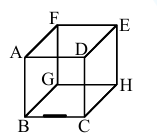
A line charge of length a2\frac{a}{2} is kept at the center of an edge BC of a cube ABCDEFGH having edge length aa. If the density of the line is λC\lambda \, \text{C} per unit length, then the total electric flux through all the faces of the cube will be : (Take ε0\varepsilon_0 as the free space permittivity)

Cube ABCDEFGH with vertices labeled A, B, C, D, E, F, G, H, and a short line charge segment drawn at the center of edge BC.
  • A

    λa8ε0\frac{\lambda a}{8 \varepsilon_0}

  • B

    λa16ε0\frac{\lambda a}{16 \varepsilon_0}

  • C

    λa2ε0\frac{\lambda a}{2 \varepsilon_0}

  • D

    λa4ε0\frac{\lambda a}{4 \varepsilon_0}

Answer

Correct answer:A

Step-by-step solution

Standard Method

Given: A line charge of length a2\frac{a}{2} is kept at the center of edge BCBC of a cube of edge length aa. The linear charge density is λ\lambda.

Find: The total electric flux through all faces of the cube.

Use Gauss's law:

Φ=qenclosedε0\Phi = \frac{q_{\text{enclosed}}}{\varepsilon_0}

The line charge lies on an edge of the cube. An edge is common to four adjacent cubes, so the given cube encloses only one-fourth of the total charge on the line segment.

Total charge on the line segment:

q=λ×a2=λa2q = \lambda \times \frac{a}{2} = \frac{\lambda a}{2}

Charge effectively enclosed by the cube:

qenclosed=14×λa2=λa8q_{\text{enclosed}} = \frac{1}{4} \times \frac{\lambda a}{2} = \frac{\lambda a}{8}

Therefore, the total electric flux through all faces of the cube is:

Φ=qenclosedε0=λa8ε0\Phi = \frac{q_{\text{enclosed}}}{\varepsilon_0} = \frac{\lambda a}{8\varepsilon_0}

Therefore, the correct option is A.

Why one-fourth of the charge is enclosed

Given: The charged segment is placed at the center of an edge of the cube.

Find: Why the enclosed charge is not the full line charge.

Imagine placing four identical cubes around that edge so that the charged segment becomes an interior line of the combined arrangement. By symmetry, the flux contribution is shared equally among the four cubes.

The full line charge is:

q=λa2q = \frac{\lambda a}{2}

Hence each cube accounts for:

q4=14(λa2)=λa8\frac{q}{4} = \frac{1}{4}\left(\frac{\lambda a}{2}\right) = \frac{\lambda a}{8}

Applying Gauss's law to the given cube:

Φ=1ε0λa8=λa8ε0\Phi = \frac{1}{\varepsilon_0} \cdot \frac{\lambda a}{8} = \frac{\lambda a}{8\varepsilon_0}

This also shows why the intermediate result λa2ε0\frac{\lambda a}{2\varepsilon_0} corresponds to the flux associated with the entire line charge, not the share enclosed by the single cube.

Common mistakes

  • Using the entire charge λa2\frac{\lambda a}{2} as enclosed by the cube. This is wrong because the charged segment lies on an edge shared by four cubes. Use only one-fourth of the total line charge for the given cube.

  • Assuming the flux must be divided equally among all six faces first. That step is unnecessary and misleading here because the question asks for the total flux through the closed surface. Apply Gauss's law directly to the enclosed charge.

  • Confusing a charge on a face with a charge on an edge. A charge lying on a face would be shared differently, but an edge is common to four cubes. Identify the geometry correctly before deciding the enclosed fraction.

Practice more Gauss's Law Applications questions

Get unlimited AI-adaptive practice, mastery tracking, and an AI tutor that explains every step — free to start.

Related questions