
The ascending acidity order of the following H atoms is:
- A
C < D < B < A
- B
A < B < C < D
- C
A < B < D < C
- D
D < C < B < A
The ascending acidity order of the following H atoms is:
C < D < B < A
A < B < C < D
A < B < D < C
D < C < B < A
Correct answer:A
Standard Method
Given: We need the ascending acidity order of the labeled hydrogen atoms A, B, C, and D.
Find: The correct increasing order of acidity.
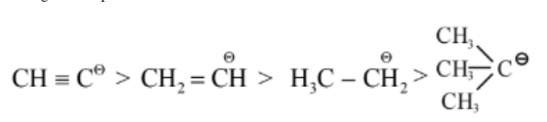
Acidity depends on the stability of the conjugate base formed after removal of the hydrogen atom. A more stable conjugate base corresponds to a stronger acid.
From the solution:
Therefore, the acidity increases as:
Hence, the correct option is A.
Hybridization-Based Comparison
Given: The compounds corresponding to A, B, C, and D are compared through the stability of their conjugate bases.
Find: The ascending order of acidity.
The solution states that acidity strength is governed by conjugate base stability. Greater conjugate base stability means greater acidity.
The comparative stability shown is:
This corresponds to the trend:
So the acidity order becomes:
Thus, the ascending order of acidity is C < D < B < A, and the correct option is A.
Assuming acidity increases with alkyl substitution of the carbon bearing hydrogen is incorrect here because the deciding factor is conjugate base stability, especially hybridization. Compare , , and carbanions first.
Reversing the trend of hybridization is a common error. A conjugate base on an carbon is more stable than on or carbon because of higher -character, so A must be most acidic.
Treating both cases as exactly identical can lead to the wrong order. The structural environment still affects carbanion stability, so D is slightly more acidic than C according to the given solution.
Get unlimited AI-adaptive practice, mastery tracking, and an AI tutor that explains every step — free to start.