
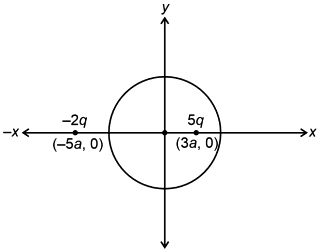
Two charges of and are situated at the points and respectively. The electric flux through a sphere of radius having its center at the origin is:
- A
- B
- C
- D
Two charges of and are situated at the points and respectively. The electric flux through a sphere of radius having its center at the origin is:
Correct answer:B
Standard Method
Given: Charges and are at and respectively. A sphere of radius is centered at the origin.
Find: The electric flux through the sphere.
Use Gauss's Law. According to Gauss's law,
The electric flux through any closed surface depends only on the net charge enclosed by that surface.
The sphere extends from to .
Hence, the enclosed charge is
Applying Gauss's law,
Therefore, the electric flux through the sphere is . The correct option is B.
Enclosed Charge Check
Given: A sphere of radius is centered at the origin, with charges at and .
Find: The electric flux through the sphere.
For flux through a closed surface, only charges inside the surface matter. Since lies within , the charge is enclosed. Since lies outside , the charge is not enclosed.
So directly,
Therefore, the correct option is B.
Including the charge at in the enclosed charge is incorrect because it lies outside the sphere of radius . Check the distance of each charge from the origin before applying Gauss's law.
Adding both charges to get is wrong because electric flux depends only on the enclosed charge, not on all charges present in space. Use only the charge inside the closed surface.
Assuming that an external charge contributes to net flux through the sphere is a conceptual error. External charges may affect the electric field on the surface, but the total flux through the closed surface depends only on enclosed charge.
Get unlimited AI-adaptive practice, mastery tracking, and an AI tutor that explains every step — free to start.