NVAEasyJEE 2023Bohr's Model & Hydrogen Spectrum

JEE Physics 2023 Question with Solution

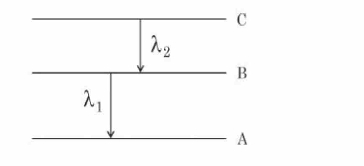
As per the given figure, AA, BB and CC are the first, second and third excited energy levels of the hydrogen atom respectively. If the ratio of the two wavelengths (λ1λ2)=74n\left(\dfrac{\lambda_1}{\lambda_2}\right) = \dfrac{7}{4n}, then the value of nn will be _____.

Energy level diagram of hydrogen atom showing three horizontal levels labeled A, B, and C, with downward transitions marked lambda1 from B to A and lambda2 from C to B.

Answer

Correct answer:5

Step-by-step solution

Standard Method

Given: AA, BB and CC are the first, second and third excited states of hydrogen, so they correspond to n=2n = 2, n=3n = 3 and n=4n = 4 respectively.

Find: The value of nn from λ1λ2=74n\dfrac{\lambda_1}{\lambda_2} = \dfrac{7}{4n}.

From the diagram, λ1\lambda_1 corresponds to the transition 323 \rightarrow 2 and λ2\lambda_2 corresponds to the transition 434 \rightarrow 3.

Using the Rydberg formula:

1λ=R(1n121n22)\frac{1}{\lambda} = R\left(\frac{1}{n_1^2} - \frac{1}{n_2^2}\right)

For λ1\lambda_1:

1λ1=R(122132)=R(1419)=R(536)\frac{1}{\lambda_1} = R\left(\frac{1}{2^2} - \frac{1}{3^2}\right) = R\left(\frac{1}{4} - \frac{1}{9}\right) = R\left(\frac{5}{36}\right)

So,

λ1=365R\lambda_1 = \frac{36}{5R}

For λ2\lambda_2:

1λ2=R(132142)=R(19116)=R(7144)\frac{1}{\lambda_2} = R\left(\frac{1}{3^2} - \frac{1}{4^2}\right) = R\left(\frac{1}{9} - \frac{1}{16}\right) = R\left(\frac{7}{144}\right)

So,

λ2=1447R\lambda_2 = \frac{144}{7R}

Now,

λ1λ2=365R1447R=36×7144×5=720\frac{\lambda_1}{\lambda_2} = \frac{\frac{36}{5R}}{\frac{144}{7R}} = \frac{36 \times 7}{144 \times 5} = \frac{7}{20}

Given,

λ1λ2=74n\frac{\lambda_1}{\lambda_2} = \frac{7}{4n}

Therefore,

74n=720\frac{7}{4n} = \frac{7}{20}

So,

4n=20n=54n = 20 \Rightarrow n = 5

Therefore, the value of nn is 55.

Direct Transition Comparison

Given: λ1\lambda_1 is for transition 323 \rightarrow 2 and λ2\lambda_2 is for transition 434 \rightarrow 3.

Find: The value of nn in λ1λ2=74n\dfrac{\lambda_1}{\lambda_2} = \dfrac{7}{4n}.

Instead of calculating wavelengths first, compare the reciprocals directly:

1λ1(1419)=536\frac{1}{\lambda_1} \propto \left(\frac{1}{4} - \frac{1}{9}\right) = \frac{5}{36} 1λ2(19116)=7144\frac{1}{\lambda_2} \propto \left(\frac{1}{9} - \frac{1}{16}\right) = \frac{7}{144}

Hence,

λ1λ2=1λ21λ1=7144536=720\frac{\lambda_1}{\lambda_2} = \frac{\frac{1}{\lambda_2}}{\frac{1}{\lambda_1}} = \frac{\frac{7}{144}}{\frac{5}{36}} = \frac{7}{20}

Comparing with

74n\frac{7}{4n}

we get

4n=204n = 20

Therefore, n=5n = 5.

This shortcut works because wavelength is inversely proportional to the transition energy term in the Rydberg relation.

Common mistakes

  • Confusing excited-state numbering with principal quantum numbers is a common mistake. The first excited state is not n=1n = 1; it is n=2n = 2. Always convert first, second, and third excited states to n=2,3,4n = 2, 3, 4 before applying the Rydberg formula.

  • Interchanging the two transitions leads to the wrong ratio. Here λ1\lambda_1 is for 323 \rightarrow 2 and λ2\lambda_2 is for 434 \rightarrow 3. Read the arrows on the energy-level diagram carefully before substituting.

  • Using the Rydberg formula with the terms in the wrong order can produce a negative reciprocal wavelength. For emission, use the lower level first and the upper level second inside (1n121n22)\left(\frac{1}{n_1^2} - \frac{1}{n_2^2}\right) so that the result remains positive.

Practice more Bohr's Model & Hydrogen Spectrum questions

Get unlimited AI-adaptive practice, mastery tracking, and an AI tutor that explains every step — free to start.

Related questions