MCQMediumJEE 2023Reaction Mechanisms (Substitution, Addition, Elimination)

JEE Chemistry 2023 Question with Solution

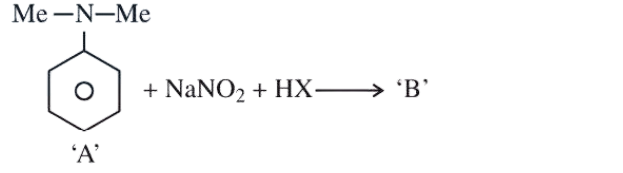
The incorrect statement regarding the reaction given below is:

Reaction scheme showing N,N-dimethylaniline labeled A reacting with NaNO2 and HX to form product B, with dimethylamino group attached to a benzene ring.
  • A

    The electrophile involved in the reaction is NO+\text{NO}^+

  • B

    'B' is N-nitroso ammonium compound

  • C

    The reaction occurs at low temperature

  • D

    The product 'B' formed in the above reaction is pp-nitroso compound at low temperature

Answer

Correct answer:D

Step-by-step solution

Standard Method

Given: N,N-dimethylaniline (A) reacts with NaNO2\text{NaNO}_2 and HX\text{HX} to form B.

Find: The incorrect statement regarding this reaction.

Explanation:

NaNO2+HXNO+\text{NaNO}_2 + \text{HX} \rightarrow \text{NO}^+

The electrophile generated in the reaction medium is NO+\text{NO}^+. This reaction is carried out at low temperature. In tertiary aromatic amines such as N,N-dimethylaniline, electrophilic substitution occurs on the ring and the major product formed is the pp-nitroso compound.

Therefore, the statement saying that B is an N-nitroso ammonium compound is incorrect. The solution marks D as correct, but its own explanation shows that statement (2) is incorrect. Hence there is a source discrepancy, and the defensible incorrect statement is option B.

Explanation from Reaction Behavior

Given: The substrate is a tertiary aromatic amine, N,N-dimethylaniline.

Find: Which statement does not match the chemistry of nitrosation under acidic conditions.

For tertiary aromatic amines, nitrosonium ion attacks the aromatic ring, mainly at the para position, rather than giving an N-nitroso ammonium product.

So:

  1. The electrophile is NO+\text{NO}^+ — correct.
  2. The reaction is done at low temperature — correct.
  3. The product is a pp-nitroso derivative at low temperature — correct.
  4. Saying B is an N-nitroso ammonium compound is incorrect.

Therefore, the chemically correct answer is option B.

Common mistakes

  • Confusing tertiary aromatic amines with primary amines. Primary amines undergo diazotization, but here the reaction gives ring nitrosation instead. Identify the class of amine first.

  • Assuming nitrosation must occur on nitrogen. For N,N-dimethylaniline, the activated benzene ring undergoes electrophilic substitution at the para position. Do not force formation of an N-nitroso product.

  • Ignoring the role of low temperature. Acidic nitrosation reactions are typically performed at low temperature to control reactive intermediates and avoid side reactions.

Practice more Reaction Mechanisms (Substitution, Addition, Elimination) questions

Get unlimited AI-adaptive practice, mastery tracking, and an AI tutor that explains every step — free to start.

Related questions