
The number of possible isomeric products formed when 3-chloro-1-butene reacts with HCl through carbocation formation is _____.
NVAMediumJEE 2023Reaction Mechanisms (Substitution, Addition, Elimination)
JEE Chemistry 2023 Question with Solution
Answer
Correct answer:4
Step-by-step solution
Standard Method
Given: 3-chloro-1-butene reacts with HCl through carbocation formation.
Find: The total number of possible isomeric products.
Step 1: Protonation of the alkene The double bond is protonated by HCl. Following Markovnikov addition, a secondary carbocation is formed.
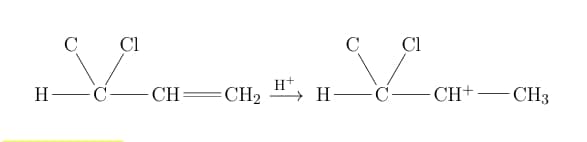
Step 2: Carbocation rearrangement The initially formed secondary carbocation undergoes a 1,2-hydride shift to generate a more stable tertiary carbocation.

Step 3: Attack by chloride ion Chloride ion can attack both carbocation intermediates.
From attack on the secondary carbocation, 1 product is formed:

From attack on the tertiary carbocation, 3 products are formed for
namely one meso compound and one pair of enantiomers.
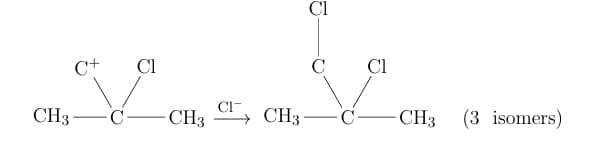
Therefore, total possible isomeric products are
So, the total number of possible isomeric products is .
Product Counting by Intermediates
Given: Addition of HCl to 3-chloro-1-butene proceeds through carbocation formation.
Find: Count all distinct isomeric products formed after direct formation and rearrangement.
The key idea is that the reaction does not stop at only one carbocation. After protonation, the initially formed carbocation can either be trapped directly by or rearrange before capture.
- Initial secondary carbocation gives one constitutional product after chloride attack.
- Rearranged tertiary carbocation gives a product with two stereogenic centers, so stereoisomerism must be counted.
- That stereochemical set contains one meso form and two enantiomers.
Thus, the total count is
Hence, the numerical value of the answer is .
Common mistakes
Counting only the product from the initially formed carbocation is incorrect because the solution shows a 1,2-hydride shift to a more stable tertiary carbocation. Both unrearranged and rearranged pathways must be considered.
Treating the tertiary-carbocation product as a single product is wrong because shows stereoisomerism. You must count one meso compound and one pair of enantiomers separately.
Ignoring rearrangement stability is a conceptual error. Carbocations often rearrange to more stable intermediates before nucleophilic attack, so product counting must include rearranged intermediates whenever the mechanism permits.
Practice more Reaction Mechanisms (Substitution, Addition, Elimination) questions
Get unlimited AI-adaptive practice, mastery tracking, and an AI tutor that explains every step — free to start.
Related questions
- A is a neutral organic compound (M.F.: C8H9ON). On treatment with aqueous Br2/HO^-, A forms a compound B…Medium · JEE 2026
- Given below are two statements: Statement I: C–Cl bond is stronger in CH2 = CH-Cl than in CH3-CH2-Cl.…Medium · JEE 2026
- Given below are two statements: Statement I: The dipole moment of R –CN is greater than R –NC and R –NC can…Medium · JEE 2026
- Grignard reagent RMgBr (P) reacts with water and forms a gas (Q). One gram of Q occupies 1.4 dm^3 at STP. (P)…Medium · JEE 2026
- Match the LIST-I with LIST-II Choose the correct answer from the options given below:Easy · JEE 2025
- Given below are two statements: Statement I: The conversion proceeds well in a less polar medium.…Easy · JEE 2025