MCQMediumJEE 2023Reaction Mechanisms (Substitution, Addition, Elimination)

JEE Chemistry 2023 Question with Solution

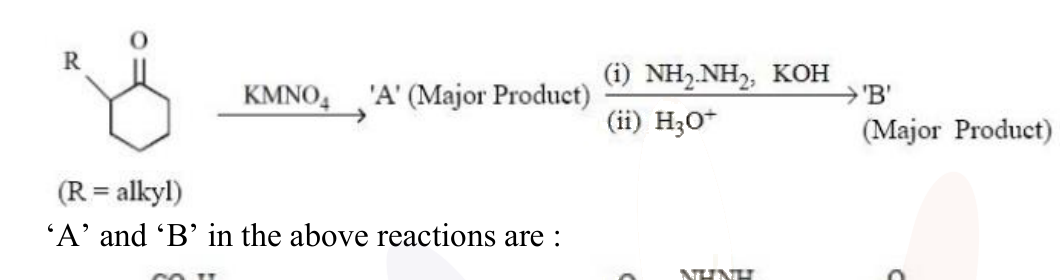
Reaction scheme showing an alkyl-substituted cyclohexanone treated with KMnO4 to give A, then NH2NH2 and KOH followed by H3O+ to give B as major product.

(R = alkyl)

'A' and 'B' in the above reactions are:

  • A
    Option showing A as a carboxylic acid chain and B as a dihydrazide-like product with terminal carbonyl hydrazine groups.
  • B
    Option showing A as a chain containing carboxylic acid and aldehyde groups, and B as the corresponding alkyl-substituted carboxylic acid.
  • C
    Option showing A as an alkyl-substituted keto-acid and B as the corresponding alkyl-substituted monocarboxylic acid after carbonyl reduction.
  • D
    Option showing A as an alkyl-substituted keto-aldehyde and B as the corresponding alkyl chain ending in methyl group.

Answer

Correct answer:C

Step-by-step solution

Standard Method

Given: An alkyl-substituted cyclic ketone is treated with KMnO4KMnO_4 to form A, and then A undergoes Wolff-Kishner reduction with NH2NH2NH_2NH_2, KOHKOH followed by H3O+H_3O^+ to form B.

Find: The correct identities of A and B.

KMnO4 oxidation converts the enolizable cyclic ketone derivative into the keto-acid A. Subsequent Wolff-Kishner reduction of the keto group gives B.

Solution scheme showing keto-enol oxidation of alkyl cyclohexanone to an open-chain keto-acid, followed by Wolff-Kishner reduction to the corresponding alkyl-substituted carboxylic acid.

Therefore, A and B correspond to option (3). The correct option is C.

Common mistakes

  • Assuming KMnO4KMnO_4 only oxidizes side chains without ring cleavage is incorrect here. The enolizable cyclic ketone undergoes oxidative cleavage to give a keto-acid. Track the transformed ring carbons before choosing A.

  • Treating Wolff-Kishner reduction as if it reduces the carboxylic acid group is wrong. Wolff-Kishner reduces the keto carbonyl to CH2CH_2, while the CO2HCO_2H group remains unchanged. Use this to identify B correctly.

  • Choosing the aldehyde-containing option is a conceptual error. Oxidative cleavage under strong KMnO4KMnO_4 conditions gives a more oxidized product, so an aldehyde is not the appropriate major product here.

Practice more Reaction Mechanisms (Substitution, Addition, Elimination) questions

Get unlimited AI-adaptive practice, mastery tracking, and an AI tutor that explains every step — free to start.

Related questions



