
L-isomer of tetrose X () gives positive Schiff's test and has two chiral carbons. On acetylation, 'X' yields triacetate. 'X' undergoes following reactions:

'X' is:
- A
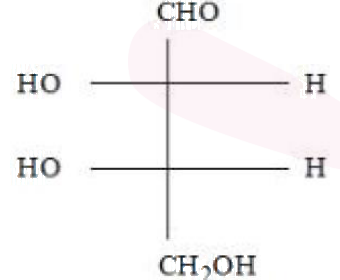
- B
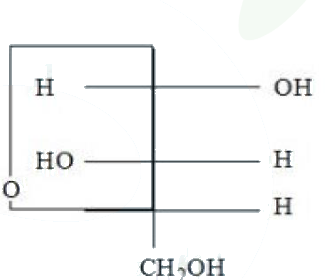
- C
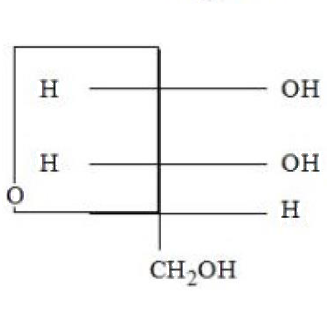
- D
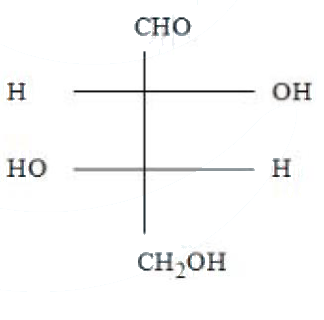
L-isomer of tetrose X () gives positive Schiff's test and has two chiral carbons. On acetylation, 'X' yields triacetate. 'X' undergoes following reactions:
'X' is:
Correct answer:D
Standard Method
Given: X is an L-tetrose with two chiral carbons, gives positive Schiff's test, and on acetylation gives triacetate.
Find: the correct structure of X.
A positive Schiff's test shows that X contains an aldehyde group, so X is an aldotetrose. Formation of triacetate means there are three alcoholic -OH groups available for acetylation in the open-chain form consistent with the given carbohydrate structure.
From the solution, oxidation with gives a dicarboxylic acid A, so both terminal groups are oxidizable as expected for an aldotetrose. Reduction with gives polyol B, and B is stated to be optically active. Therefore, the reduced product cannot be a meso tetritol.
The solution working identifies the structure that satisfies all these conditions as the L-tetrose shown in option (4).
Therefore, the correct option is D.
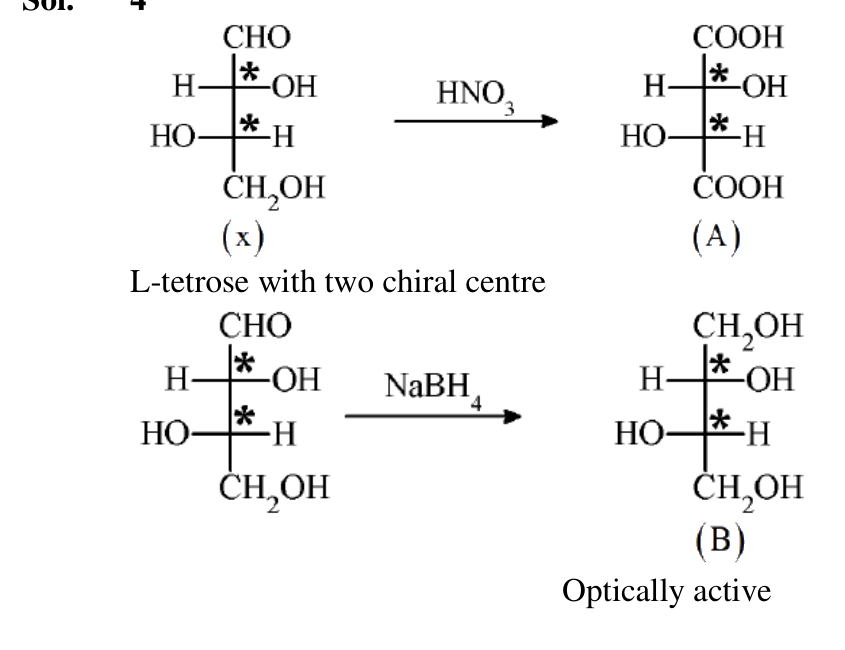
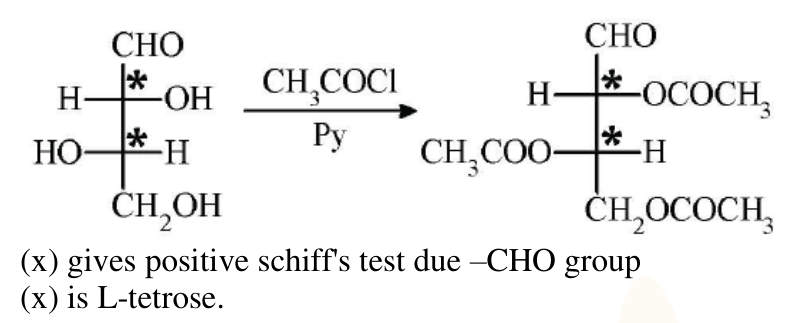
Using the reaction clues
Given: X is an L-isomer of tetrose and reacts as described.
Find: which option matches X.
Among the given structures, the one consistent with the L-configuration and the reaction products shown in the solution is option (4).
Hence, X = option D.
Mistake: Treating positive Schiff's test as evidence for any carbonyl group. Why wrong: Schiff's reagent is used here to identify an aldehyde functionality, not a ketose in the same way. What to do instead: First conclude that X is an aldotetrose containing .
Mistake: Ignoring the statement that the reduced product B is optically active. Why wrong: some tetritols can be meso and hence optically inactive. What to do instead: use the optical activity of B to eliminate structures that would give a meso polyol after reduction.
Mistake: Choosing a D-isomer instead of an L-isomer by reading the Fischer projection incorrectly. Why wrong: the D/L label depends on the configuration at the chiral center farthest from the carbonyl group. What to do instead: inspect the lowest chiral center carefully before assigning L or D.
Get unlimited AI-adaptive practice, mastery tracking, and an AI tutor that explains every step — free to start.