MCQMediumJEE 2023Electronic Effects (Inductive, Resonance, Hyperconjugation)

JEE Chemistry 2023 Question with Solution

The decreasing order of hydride affinity for following carbonations is:
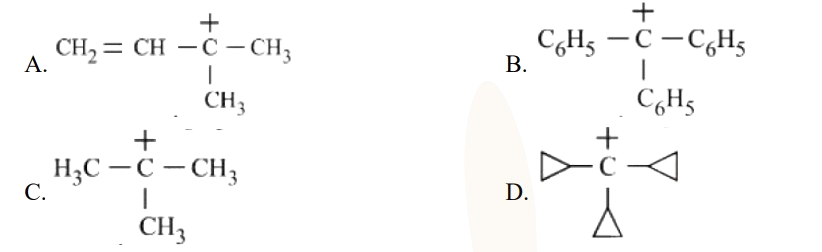
Four carbocations labeled A, B, C and D are shown with different substituents for comparing hydride affinity order.

Choose the correct answer from the options given below:

  • A

    C, A, D, B

  • B

    A, C, B, D

  • C

    A, C, D, B

  • D

    C, A, B, D

Answer

Correct answer:D

Step-by-step solution

Standard Method

Given: Four carbocations A, B, C and D are to be arranged in decreasing order of hydride affinity.

Find: The correct decreasing order.

Analyzing the stability and hydride affinity of the given carbocations.

Carbocation A is stabilized through conjugation with a double bond.

Carbocation B is stabilized by conjugation with three phenyl rings, making it the most stable and thus possessing the highest hydride affinity.

Carbocation D is the least stable due to the absence of resonance and inductive effects.

Therefore, the decreasing order of hydride affinity is: C, A, B, D.

The correct option matching this order is D. Note that the solution labels the option as C, but the listed order corresponds to option (4) in the options provided.

Common mistakes

  • Confusing carbocation stability with hydride affinity directly can lead to a wrong order. First compare stabilization by resonance and conjugation, then infer the relative tendency associated with hydride acceptance.

  • Ignoring resonance with adjacent π\pi systems is incorrect. A carbocation conjugated with a double bond or aromatic rings is significantly different from a purely alkyl carbocation.

  • Assuming triphenyl-stabilized and simple alkyl carbocations behave similarly is wrong. Extensive delocalization changes the electronic demand substantially, so resonance-supported species must be treated separately.

Practice more Electronic Effects (Inductive, Resonance, Hyperconjugation) questions

Get unlimited AI-adaptive practice, mastery tracking, and an AI tutor that explains every step — free to start.

Related questions