
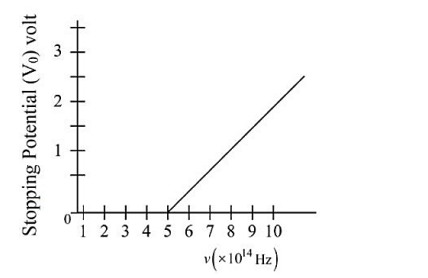
The variation of stopping potential () as a function of the frequency () of the incident light for a metal is shown in the figure. The work function of the surface is:
- A
- B
- C
- D
The variation of stopping potential () as a function of the frequency () of the incident light for a metal is shown in the figure. The work function of the surface is:
Correct answer:A
Standard Method
Given: The graph shows stopping potential versus frequency for the incident light.
Find: The work function of the metal surface.
For photoelectric emission,
At threshold frequency, stopping potential becomes zero, so
From the graph, the threshold frequency is approximately
Therefore,
Converting into electron volt,
Therefore, the work function is . Although the solution labels the correct option as C, the worked calculation clearly gives , which corresponds to option A.
Using the slope of the graph to calculate the work function directly is wrong because the work function depends on the threshold frequency, not on the slope. First read the -axis intercept where .
Reading the threshold frequency incorrectly from the graph leads to the wrong answer. The line starts near , so that value must be used for .
Forgetting to convert joules to electron volts is incorrect because the options are given in eV. After finding in joules, divide by to express it in electron volts.
Get unlimited AI-adaptive practice, mastery tracking, and an AI tutor that explains every step — free to start.