MCQMediumJEE 2023Detection of Functional Groups

JEE Chemistry 2023 Question with Solution

Isomeric amines with molecular formula C8H11N\mathrm{C_8H_{11}N} give the following tests:

(P) Can be prepared by Gabriel phthalimide synthesis. (Q) Reacts with Hinsberg’s reagent to give a solid insoluble in NaOH\mathrm{NaOH}. (R) Reacts with HONO\mathrm{HONO} followed by β\beta-naphthol in NaOH\mathrm{NaOH} to give a red dye.

Isomer (P), (Q), and (R), respectively, are:

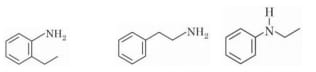
  • A
    Three amine structures are shown as option 1, including benzyl-substituted and aromatic amine isomers with different amine classes.
  • B
    Three amine structures are shown as option 2, containing one primary aliphatic amine, one secondary amine, and one aromatic primary amine isomer.
  • C
    Three amine structures are shown as option 3, including aromatic and aliphatic amine isomers with varying substitution patterns and amine classes.
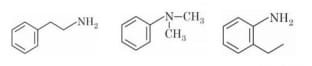
  • D
    Three amine structures are shown as option 4, consisting of one primary amine, one tertiary amine, and one aromatic primary amine isomer.

Answer

Correct answer:D

Step-by-step solution

Standard Method

Given: Isomeric amines with molecular formula C8H11N\mathrm{C_8H_{11}N} are identified using three qualitative tests.

Find: Which set of structures corresponds to (P), (Q) and (R) respectively.

The solution states that Gabriel phthalimide synthesis is specific to primary amines. Therefore (P) must be a primary amine.

Hinsberg’s reagent gives a solid product insoluble in NaOH\mathrm{NaOH} with a secondary amine. Therefore (Q) must be a secondary amine.

Reaction with HONO\mathrm{HONO} followed by β\beta-naphthol in NaOH\mathrm{NaOH} gives a red dye for an aromatic primary amine. Therefore (R) must be an aromatic primary amine.

So the correct option must contain, in order:

  1. a primary amine,
  2. a secondary amine,
  3. an aromatic primary amine.

The provided the solution explicitly concludes:

The Correct Option is D

and also writes Final Answer: (4). Hence the matching option is D.

Therefore, the correct option is D.

Test-Based Identification

Given:

  • (P) can be prepared by Gabriel phthalimide synthesis.
  • (Q) reacts with Hinsberg’s reagent to give a solid insoluble in NaOH\mathrm{NaOH}.
  • (R) reacts with HONO\mathrm{HONO} and then with β\beta-naphthol in NaOH\mathrm{NaOH} to form a red dye.

Find: The correct ordered set of isomeric amines.

For (P): Gabriel phthalimide synthesis is used for preparing primary aliphatic amines. So the first structure must be a primary amine.

For (Q): In the Hinsberg test, secondary amines form sulfonamides that are insoluble in alkali. So the second structure must be a secondary amine.

For (R): Formation of a red dye after treatment with nitrous acid and coupling with β\beta-naphthol indicates diazotization followed by azo coupling. This is characteristic of an aromatic primary amine. So the third structure must be an aromatic primary amine.

Comparing these requirements with the options, the solution identifies option (4), which corresponds to D.

Therefore, (P), (Q), (R) are given by option D.

Common mistakes

  • Confusing Gabriel phthalimide synthesis as a method for all amines is incorrect. It is used to prepare primary amines, not secondary or tertiary amines. First identify the amine class before matching the structure.

  • In the Hinsberg test, many students mix up the solubility behavior of primary and secondary amines. A product insoluble in NaOH\mathrm{NaOH} indicates a secondary amine, not a primary amine. Use the alkali-solubility criterion carefully.

  • Assuming that any amine can give the diazo coupling red dye test is wrong. This test is characteristic of an aromatic primary amine because diazotization requires the amino group directly attached to an aromatic ring. Do not choose an aliphatic primary amine for (R).

Practice more Detection of Functional Groups questions

Get unlimited AI-adaptive practice, mastery tracking, and an AI tutor that explains every step — free to start.

Related questions