
Identify the correct order of reactivity for the following pairs towards the respective mechanism:
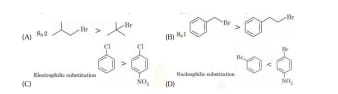
- A
(A) , (C), and (D) only
- B
(A) , (B), and (D) only
- C
(B) , (C), and (D) only
- D
(A) , (B), (C), and (D)
Identify the correct order of reactivity for the following pairs towards the respective mechanism:
(A) , (C), and (D) only
(A) , (B), and (D) only
(B) , (C), and (D) only
(A) , (B), (C), and (D)
Correct answer:D
Standard Method
Given: Four proposed orders of reactivity are shown for SN2, SN1, electrophilic substitution, and nucleophilic substitution.
Find: Which of the statements (A), (B), (C), and (D) are correct.
For SN2, steric hindrance controls the rate. The less hindered substrate reacts faster, so the stated order with increasing substitution is correct.
For SN1, the reaction proceeds through a carbocation intermediate. A benzylic carbocation is highly stabilized by resonance with the aromatic ring, so the given order is correct.
For electrophilic aromatic substitution, electron-donating groups activate the ring, while electron-withdrawing groups deactivate it. Also, Cl is weakly deactivating, whereas NO2 is strongly deactivating. Hence, the given order is correct.
For nucleophilic aromatic substitution, strong electron-withdrawing groups at ortho or para positions stabilize the intermediate and increase reactivity. NO2 enhances this reactivity much more than Br, so the given order is correct.
Therefore, (A), (B), (C), and (D) are all correct. The correct option is D.
Mechanism-wise Explanation
Given: The question compares reactivity orders for four different mechanisms.
Find: Check each statement separately.
Conclusion: All four statements are correct, so the correct option is D.
Assuming the same factor controls all four mechanisms is incorrect. SN2 depends strongly on steric hindrance, whereas SN1 depends on carbocation stability. Check the controlling intermediate or transition state for each mechanism separately.
Treating Cl and NO2 as similar deactivating groups in aromatic substitution is wrong. NO2 is a much stronger electron-withdrawing group, so its effect on electrophilic and nucleophilic aromatic substitution is much greater.
Ignoring resonance stabilization in benzylic systems leads to an incorrect SN1 order. Benzylic carbocations are especially stable due to delocalization, so resonance effects must be considered before comparing reactivity.
Get unlimited AI-adaptive practice, mastery tracking, and an AI tutor that explains every step — free to start.